Question
What are significant figures? State rules to determine it.

Answer

SELF

Need a full question paper?

Generate a complete, print-ready paper with questions like this in minutes — across 16+ boards, with answer keys.

Start Generating Free

Similar questions

  1. Derive the mathematical expression for first law of thermodynamics.
  2. Calculate the $\Delta_\text{r}\text{H}^\circ$ for the reaction:

H2(g) + Br2(g) → 2HBr(g)

Bond enthalpy are given as, H-H = 436kJ mol-1, Br-Br = 192kJ mol-1 and H-Br = 368kJ mol-1
Write a relation between $\triangle G$ and Q and define the meaning of each term and answer the following:
a. Why a reaction proceeds forward when $Q < K$ and no net reaction occurs when $Q = K$.
b. Explain the effect of an increase in pressure in terms of reaction quotient Q for the reaction:
$
CO(g)+3 H_2(g) \rightleftharpoons CH_4(g)+H_2 O(g)
$
What is mole concept? What is relation with molar mass of substance and number of molecule.
The equilibrium constant for the following reaction is 1.6 ×10⁵ at 1024K $\text{H}_2\text{ (g) + Br (g)}\rightleftharpoons2\text{HBr (g)}$ Find the equilibrium pressure of all gases if 10.0 bar of HBr is introduced into a
sealed container at 1024K.
Compare the acidic properties of alkane, alkene and alkyne and write reaction to represent the acidic nature of 1-alkyne.
The pH of 0.1M solution of cyanic acid (HCNO) is 2.34. Calculate the ionization constant of the acid and its degree of ionization in the solution.
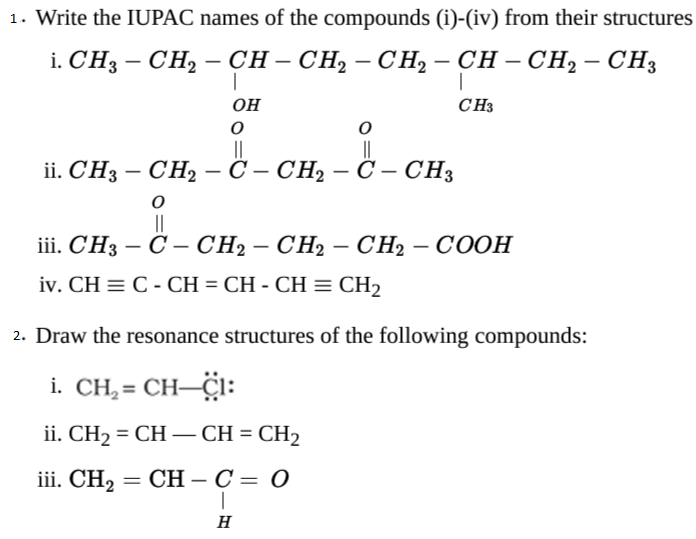
Image
Why is benzene extra ordinarily stable though it contains three double bonds?
One of the reaction that takes place in producing steel from iron ore is the
reduction of iron(II) oxide by carbon monoxide to give iron metal and CO2.
$\text{FeO (S) + CO (g)}\rightleftharpoons\text{Fe (S) + CO}_2\text{ (g)};\text{ K}_{\text{p}}=0.265\text{atm at}1050\text{K}$
What are the equilibrium partial pressures of CO and CO2 at 1050 K if the initial partial pressures are: pCO= 1.4atm and = 0.80atm?
Write the expression for the equilibrium constant, $K _{ c }$ for each of the following reactions :
(i) $2 NOCl ( g ) \rightleftharpoons 2 NO ( g )+ Cl _2(g)$
(ii) $2 Cu \left( NO _3\right)_2(s) \rightleftharpoons 2 CuO ( s )+4 NO _2(g)+ O _2(g)$
(iii) $CH _3 COOC _2 H _5( aq )+ H _2 O ( l ) \rightleftharpoons$$CH _3 COOH ( aq )+ C _2 H _5 OH ( aq )$
(iv) $Fe ^{3+}( aq )+3 OH ^{-}( aq ) \rightleftharpoons Fe ( OH )_3(s)$
(v) $I _2(s)+5 F_2(g) \rightleftharpoons 2 IF _5$