Question
What are space expeditions? Explain their need and importance in your words. (Practice Activity Sheet – 2)

Answer

A mission planned (i) for establishing artificial satellites in the earth’s orbit, using them for research or for the benefit of life, or (ii) for sending a spacecraft to the various components of the solar system or outside is called a space expedition.

Man has always been curious about the sun, moon, stars and the world beyond the earth. Initially, man tried to observe space with the help of telescopes. However, later he dreamt to fly into space and finally succeeded to reach into space. Space missions are now essential to understand the origin and evolution of our solar system as well as to study the Universe beyond the Solar system.

Space missions have given us many benefits and made our life simpler. It is because of space missions that the real-time immediate communication and exchange of information across the globe is now possible. We can receive the abundant information at the desk at our home or office. We also get information about any topic at any time and anywhere at fingertips through the Internet. Besides, the advanced alerts about some natural calamities like cyclones or storms are received through satellites sent as a part of space missions. Satellites have also helped us in entertainment. Programmes, sports events, etc., can be telecast live and can reach millions at a time throughout the world.

Satellite surveillance of the enemy, exploring the reserves of various minerals resources, access to various activities like trade, tourism and navigation, and easy global reach to make world a global village is all possible due to the space missions. Thus, space missions are extremely important in defence, communication, weather forecast, observation, direction determination, etc.

Need a full question paper?

Generate a complete, print-ready paper with questions like this in minutes — across 16+ boards, with answer keys.
Start Generating Free

Similar questions

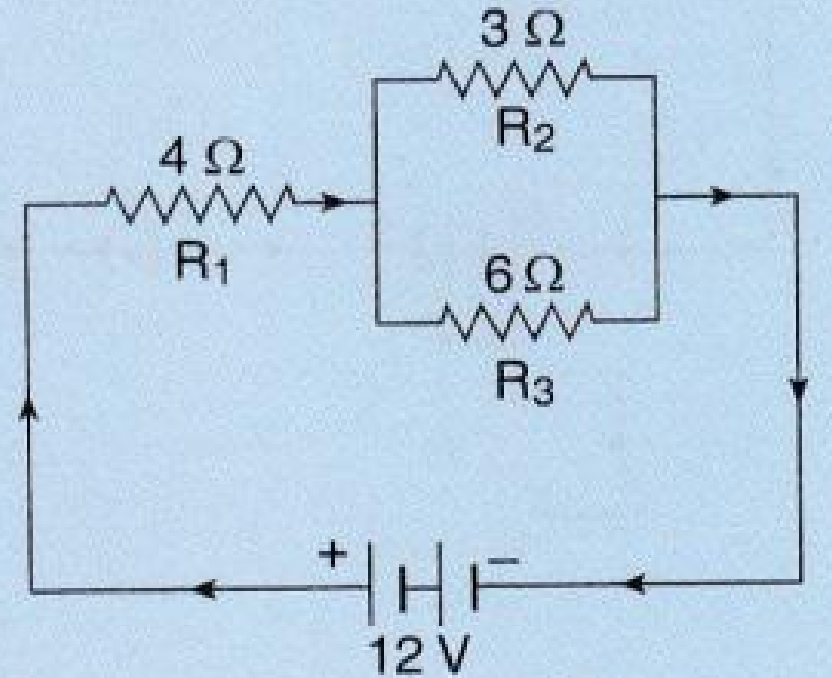
The circuit diagram given below shows the combination of three resistors $R_1, R_2$ and $R_3$:

Find:
  1. Total resistance of the circuit.
  2. Total current flowing in the circuit.
  3. The potential difference across $R.$
What is menstrual cycle? Describe it in brief.
Why are geostationary satellites not useful for studies of polar regions? (Practice Activity Sheet – 4)
(OR)
Explain the following statement. A geostationary satellite is not useful in the study of polar regions. (Practice Activity Sheet – 1)
State and explain the reaction, if any, of the following metals with a solution of copper sulphate:
  1. Gold.
  2. Copper.
  3. Zinc.
  4. Mercury.
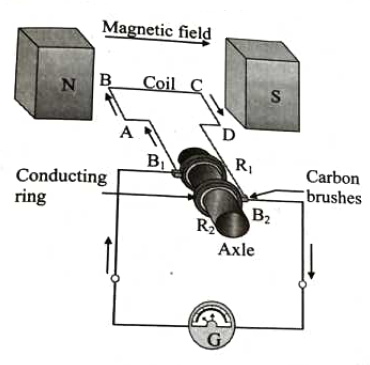
Observe the following diagram and write the answers of the given sub-questions:
Image

i. Which instrument the above figure shows?
ii. Which rule is used to determine the direction of the current produced?
iii. State the rule.
iv. In which direction ( $B_1$ to $B_2$ or $B_2$ to $B_1$ ) will the current flow in the external circuit in that situation?
v. What change will have to be made in the coil for increasing the current several times without changing the magnet?
A and B are the two systems of control and coordination in the human body. The messages in system A are transmitted in the form of chemical substances C which travel comparatively slowly through the blood stream. The substances C are made in tissues D present in the head and trunk of human body. The messages in system b are transmitted very quickly in the form of electrical impulses through fibres E. The effect of messages transmitted by system b usually lasts for a much shorter time as compared to those transmitted by system A.
  1. Name the system A. What does system A consist of?
  2. Name the chemical substance C.
  3. What is tissue D? Name any five such tissues in the human body.
  4. Name the system B. What does system B consist of?
  5. Name the fibres E.
  6. State whether system A controls the working of system B or system B controls the working of system A.
Write short note :
Transition Elements.
A unicellular animal P having no fixed shape ingests a food particle by forming temporary finger-like projections Q. The food particle is engulfed with a little surrounding water to form a temporary stomach R inside it. The chemicals S from surrounding cytoplasm enter into R and break down food into small and soluble molecules by chemical reactions. The digested food is absorbed directly into cytoplasm by the process T. The undigested food is thrown out of the body by the rupture of a cell organelle U in a process called V.
  1. Name the unicellular animal P.
  2. What are (i) Q, and (ii) R?
  3. Name (i) chemical S, and (ii) process T.
  4. Name (i) organelle U, and (ii) process V.
When a mixture of gases $X$ and $Y$ is compressed to $300$atm pressure and then passed over a catalyst consisting of a mixture of zinc oxide and chromium oxide $($heated to a temperature of $300^\circ C),$ then an organic compounds $Z$ having the molecular formula $CH_4O$ is formed. $X$ is a highly poisonous gas which is formed in appreciable amounts when a fuel burns in a limited supply of air; $Y$ is a gas which can be made by the action of a dilute acid on an active metal; and $Z$ is a liquid organic compound which can react with sodium metal to produce hydrogen gas:
  1. What are $X, Y$ and $Z?$
  2. Write a balanced chemical equation of the reaction which takes place when $X$ and $Y$ combine to form $Z.$ Indicate the conditions under which the reaction occurs.
With the help of a labelled ray-diagram, describe how a plane mirror forms an image of a point source of light placed in front of it. State the characteristics of the image formed in a plane mirror.