Question
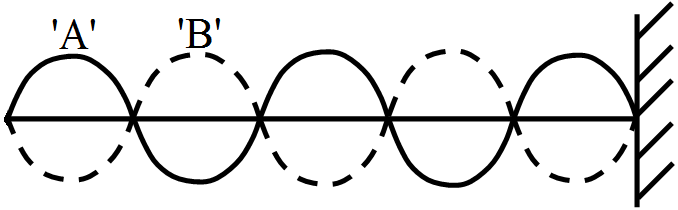
What are standing waves? Discuss graphical method for formation of standing waves on stretched strings.

Answer

Standing waves are the pattern of waves produced when two waves moving in opposite direction interact. They do not transport energy.

If a wave ‘A’ is made to hit a rigid support, there will be a reflected wave 'B' from the rigid support. As the two waves are super imposed, there will be a standing wave (as shown) produced.
It can be represented by the equation, $\text{y}=2\text{A}\sin\text{kx}\cos\omega\text{t}$indicating a position varying amplitude $(2\text{A}\sin\text{kx})$

Need a full question paper?

Generate a complete, print-ready paper with questions like this in minutes — across 16+ boards, with answer keys.
Start Generating Free

Similar questions

Two strips of metal are riveted together at their ends by four rivets, each of diameter $6.0mm$. What is the maximum tension that can be exerted by the riveted strip if the shearing stress on the rivet is not to exceed $6.9 \times 10^7 Pa$? Assume that each rivet is to carry one quarter of the load.
Molecules in air in the atmosphere are attracted by gravitational force of the earth. Explain why all of them do not fall into the earth just like an apple falling from a tree.
A current loop of arbitrary shape lies in a uniform magnetic field B. Show that the net magnetic force acting on the loop is zero.
A mass is projected horizontally with a velocity u from a tower. Find the horizontal length it will cover from the foot of the tower?
A certain sample of a radioactive material decays at the rate of $500$ per second at a certain time. The count rate falls to $200$ per second after $50$ minutes.
  1. What is the decay constant of the sample?
  2. What is its half$-$life?
A monochromatic light source of intensity $6mW$ emits $8 \times 10^{16}$ photons per second. This light ejects photoelectrons from a metal surface. The stopping potential for this setup is $2.0V$. Calculate the work function of the metal.
A dumb-bell consists of two identical small balls of mass $\frac{1}{2}\text{kg}$ each connected to the two ends of a 50cm long light rod. The dumb-bell is rotating about a fixed axis through the centre of the rod and perpendicular to it at an angular speed of 10rad/s. An impulsive force of average magnitude 5.0N acts on one of the masses in the direction of its velocity for 0.10s. Find the new angular velocity of the system.
A spaceship is launched into a circular orbit close to earth's surface. What additional velocity has to be imparted to the spaceship in the orbit to overcome the gravitational pull? Radius of earth = $6400km$ and $g = 9.8ms^{-2}$.
Plot the corresponding reference circle for each of the following simple harmonic motions. Indicate the initial (t = 0) position of the particle, the radius of the circle, and the angular speed of the rotating particle. For simplicity, the sense of rotation may be fixed to be anticlockwise in every case: (x is in cm and t is in s).$\text{x}=-2\sin\Big(3\text{t}+\frac{\pi}{3}\Big)$
A mosquito is sitting on an L.P. record disc rotating on a turn table at $33\frac{1}{3}$ revolutions per minute. The distance of the mosquito from the centre of the turn table is 10cm. Show that the friction coefficient between the record and the mosquito is greater than $\frac{\pi^2}{81}.$ Take $g =10 m/s^2$.