Question
What are stomata? Give two functions of stomata.

Answer

The tiny pores present on the surface of leaves are called stomata.
Functions of stomata are as follows
(i) Stomata help in the exchange of gases.
(ii) The water evaporates through the stomata present on the surface of the leaves by the process of transpiration.

Need a full question paper?

Generate a complete, print-ready paper with questions like this in minutes — across 16+ boards, with answer keys.
Start Generating Free

Similar questions

The image formed by a lens is always virtual, erect and smaller in size for an object kept at different positions in front of it. Identify nature of lens.
Last Sunday, Priyanka decided to go outside with her family for the dinner in some particular restaurant. Then, she thought to go through her own car. So, while moving she increased the speed of the car from $36\ km/h$ to $54\ km/h$. All of sudden, a rickshaw came in front of her car but due to applying of brakes at the right time, both of them got safe from meeting with an accident.
  1. Calculate the increase in the speed of the car in the terms of m/s.
  2. Mention a positive action performed by Priyanka here.
Why is it important to perform experiments according to Class 7 Science Curiosity Chapter 1?
Explain why burning of wood and cutting it into small piece are considered as two different types of changes.
Differentiate between:
Maximum and minimum temperatures of the day.
Name the different types of graphs.
Autotrophs and heterotrophs are two different organisms with distinct modes of nutrition state. How are they different from each other?
Why is transport of materials necessary in a plant or in an animal? Explain.
Explain why Calamine solution is applied on the skin when an ant bites.
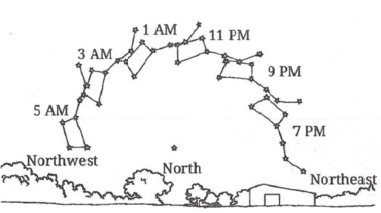
Refer to the sketch provided, which shows the positions of the Big Dipper constellation in the night sky from 7 PM to 5 AM, as observed by a student in Pune on the night of 1-2 April.
Image
(a) What causes the Big Dipper to appear to move across the night sky in a circular path around the Pole Star? Explain the scientific reason behind this observation.
(b) Based on the positions shown in the sketch, describe the apparent direction of movement of the Big Dipper. What does this tell us about the Earth's motion?