Question
What are the differences between the mass of the object and its weight?

Answer

MassWeight
Mass is a property of matter. The mass of an object is the same everywhere,Weight depends on the effect of gravity. Weight varies according to location.
Mass can never be zero.Weight can be zero if no gravity acts upon an object, as in space.
Mass does not change according to location.Weight increases or decreases with higher or lower gravity.
Mass is a scalar quantity. It has magnitude.Weight is a vector quantity. It has magnitude and is directed toward the center of the Earth or other gravity well.
Mass may be measured using an ordinary balance.Weight is measured using a spring balance.
Mass usually is measured in grams and kilograms.Weight is measured using a spring balance.

Need a full question paper?

Generate a complete, print-ready paper with questions like this in minutes — across 16+ boards, with answer keys.
Start Generating Free

Similar questions

Write an essay on crop protection management.
State the law of constant proportions. Give one example to illustrate this law.
There are four substances $W, X, Y$ and $Z$. The substance $W$ is a dark violet solid having diatomic molecules. A solution of $W$ in alcohol is used as a common antiseptic $C$. The substance $X$ is a white solid which is usually recovered from sea water on a large scale. The substance $Y$ is a white solid which is insoluble in water and used in the form of small balls for the safe storage of woollen clothes. The substance $Z$ is a yet another white solid which is used in making commonly used dry cells.
  1. Name (i) $W$ (ii) $X$ (iii) $Y$ and (iv) $Z$.
  2. Out of $W, X, Y$ and $Z$, which substance/ substances can undergo sublimation?
  3. Which substances organic in nature?
  4. What is the name of substance $C$?
  5. Which substance belongs to the halogen family?

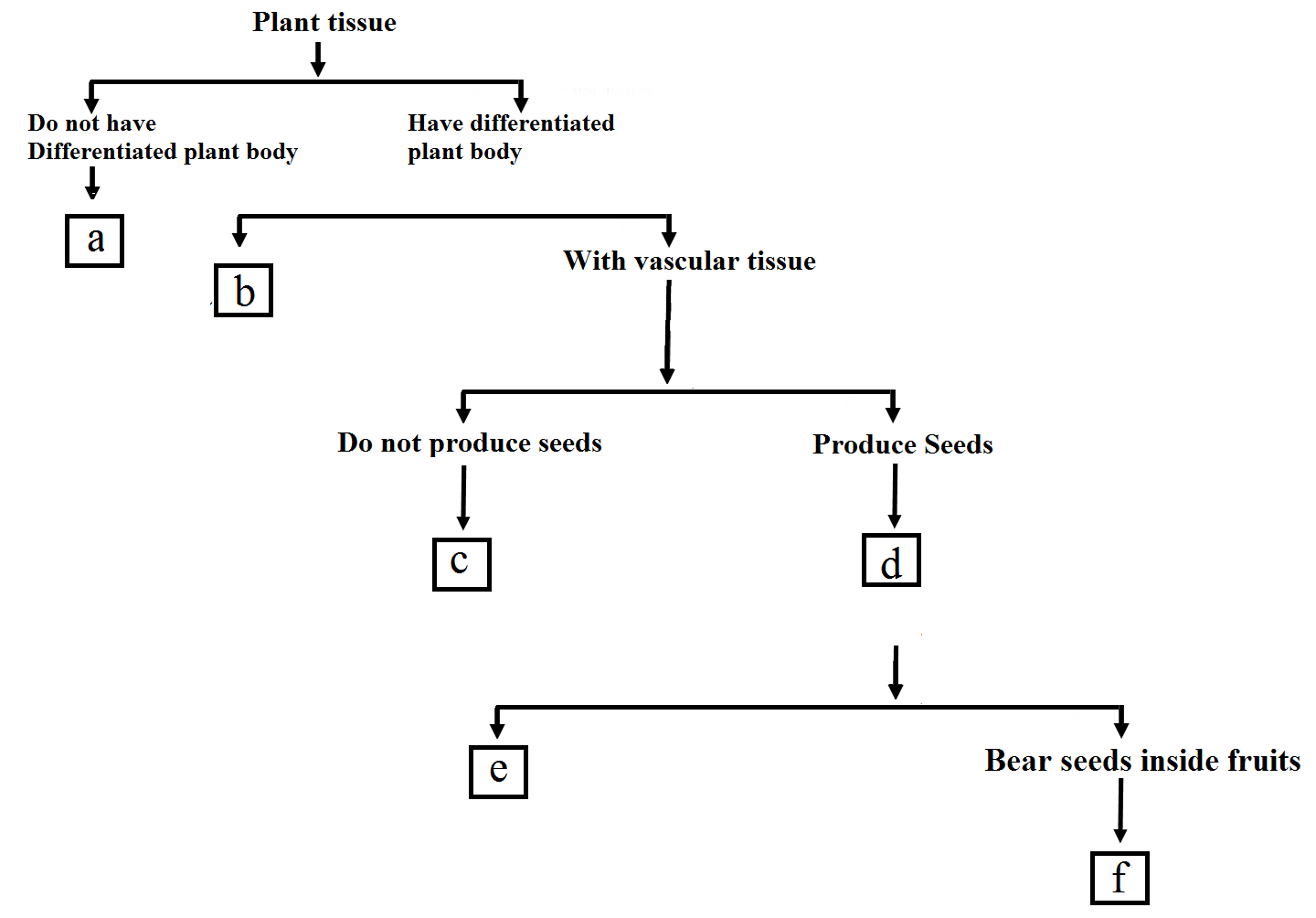
In the given classification scheme fill in the boxes with appropriate plant groups:
When extremely small particles $X$ derived from the another of a flower were suspended in a liquid $Y$ and observed through a microscope, it was found that the particles $X$ were moving throughout the liquid $Y$ in a very zig zag way. It was also observed that warmer the liquid $Y,$ faster the particles $X$ moved in its surface.
  1. What could particles $X$ be$?$
  2. What do you think liquid $Y$ is$?$
  3. What is the zig-zag movement of particles $X?$
  4. What is causing the zig-zag movement of particles $X?$
  5. Name the scientist who discovered this phenomenon.
  6. What does this experiment tell us about the nature of liquid $Y?$
i. Suppose the mass of the earth somehow increases by 10% without any change in its size. What would happen to your weight?
ii. Suppose the radius of the earth becomes twice of its present radius without any change in its mass. What will happen to your weight?
Following are a few organisms: Which among the above can grow on stones; and also help in formation of soil? Write the mode of their action for making soil.
Write a note on cattle feed.
Name two indigenous and two exotic breeds of poultry. Write a note on egg production and broiler production.
How can you obtain pure water from a salt-water mixture (or salt-solution)? Draw a meat and labelled diagram of the apparatus you would use to obtain pure water from a salt-water mixture (or salt-solution).