Question
What are the different methods of constructing Index numbers?
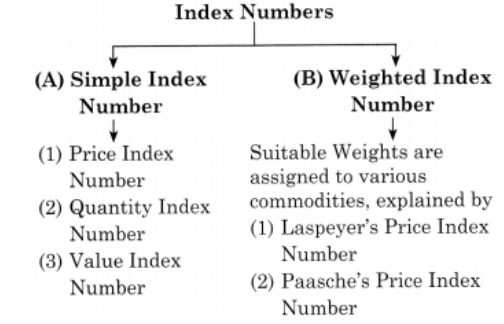
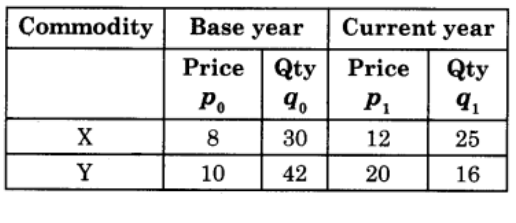
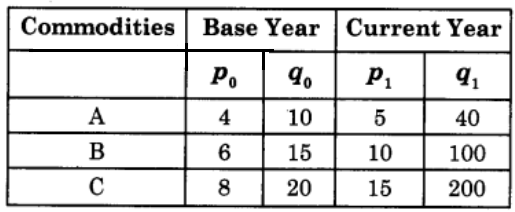
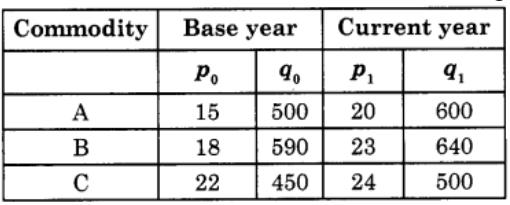
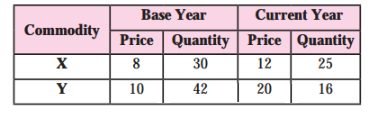
(A) Simple Index Number : A Simple Index Number is constructed when all the items like food, clothing, transport, housing, etc. are given equal importance. There are three methods of constructing it.
1. Price Index Number : It is calculated using the following formula:
$
P _{01}=\frac{\Sigma p_1}{\Sigma p_0} \times 100
$
where $- P _{01}=$ Price Index Number
$\Sigma p_1=$ Total of the current year price of various commodities.
$\Sigma p _0=$ Total of base year prices of various commodities.
2. Quantity Index Number : It is calculated by using the following formula :
Quality Index Number $Q _{01}=\frac{\Sigma q_1}{\Sigma q_0} \times 100$
where, $\Sigma q_1=$ Sum total of current year quantities of all commodities
$\Sigma q_0=$ Sum total of base year quantities of all commodities
3. Value Index Number : It is calculated by using the following formula:
Value Index Number $V _{01}=\frac{\Sigma p_1 q_1}{\Sigma p_0 q_0} \times 100$
where, $\Sigma p_1 q_1=$ Sum total of the product of the prices and quantities of the current year
$\Sigma p _0 q _0=$ Sum total of the product of the prices and quantities of the base year.
(B) Weighted Index Number : Under this method, physical quantities are used as weights, therefore prices themselves are weighted by quantities. We can take either the base year quantities or current year quantities as weights or the average of the two.
These index numbers are the simple aggregative type with the fundamental difference that weights are assigned to the various items included in the index.
There are two methods of constructing it.
(1) Laspeyre’s Method
(2) Paasche’s Method
(1) Laspeyre’s Method : This method was devised by Laspeyre’s, a German economist in 1871. In this method the weights are determined by quantities in the base year.
$
P _{01}=\frac{\Sigma p_1 q_0}{\Sigma p_0 q_0} \times 100
$
where, $P _{01}=$ Price Index Number.
$p _0=$ Prices of the base year.
$q_0=$ Quantities of the base year,
$p _1=$ Prices of the current year.
$\Sigma p_1 q_0=$ Sum of all the products of $p$, and $q_0$.
$\Sigma p_0 q_0=$ Sum of all the products of $p 0$ and $q_0$.
(2) Paasche’s Method : This method was devised by a German economist known as Hermann Paasche in 1874. The weights of current year are used as base year in constructing the Index Number.
$
P _{01}=\frac{\Sigma p_1 q_1}{\Sigma p_0 q_1} \times 100
$
where, $P _{01}=$ Price Index Number.
$p_1=$ Prices of the current year.
$q_1=$ Quantities of the current year.
$p _0=$ Prices of the base year.
$\Sigma p_1 q_1=$ Sum of all the products of $p_1$ and $q_1$,
$\Sigma p_0 q_1=$ Sum of all the products of $p_0$ and $q_1$
Generate a complete, print-ready paper with questions like this in minutes — across 16+ boards, with answer keys.