Question
What are the different pre-zygotic isolating mechanisms?

Answer

(1) Pre-zygotic or pre-mating isolating mechanisms do not allow individuals to mate with each other at all.

(2) By various mechanisms the two groups remain isolated. These mechanisms are of following types:
(i) Habitat isolation : Habitat isolation is the phenomenon in which members of a population living in the same region occupy different habitats. Hence the potential mates do not interbreed among themselves.

(ii) Seasonal isolation : In seasonal isolation, members of a population share the same region but attaining sexual maturity at the different times of the year. They thus remain isolated reproductively preventing interbreeding among themselves.

(iii) Ethological isolation : Ethological isolation is seen when members of two populations have different mating behaviours. This prevents interbreeding.

(iv) Mechanical isolation : Mechanical isolation is seen when the members of two populations have differences in the structure of reproductive organs. Due to such differences interbreeding is not possible.

Need a full question paper?

Generate a complete, print-ready paper with questions like this in minutes — across 16+ boards, with answer keys.
Start Generating Free

Similar questions

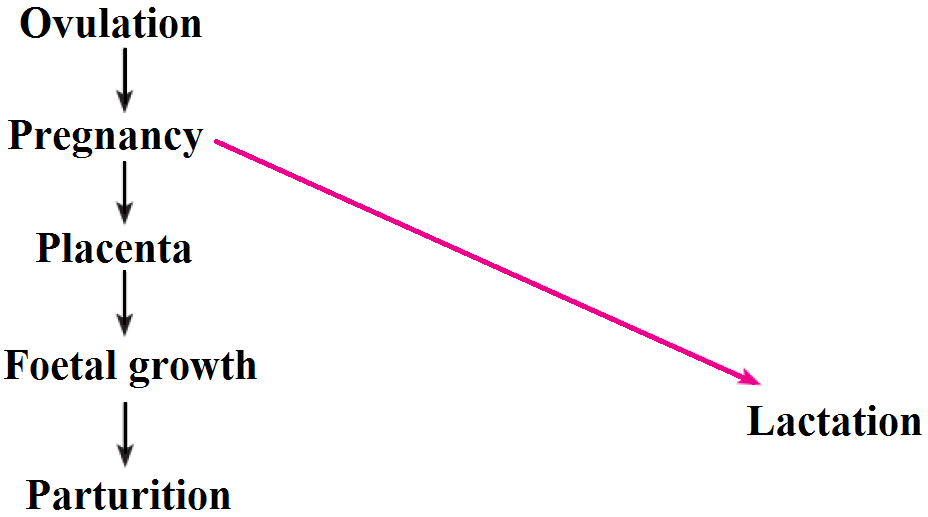
Study the flow chart given below. Name the hormones involved at each stage and explain their role.
Fill in the blanks,
Species A
Species B
Type of Interaction
Example
+
+
+
-
+
_____
_____
_____
Commensalism
_____
_____
_____
What are the four categories of ecosystem services as given by Millennium Ecosystem Assessment Report in 2005? What are the services included in each?
The following is the illustration of the sequence of ovarian events (a – i) in a human female.
Draw a labelled sketch of the structure of a human ovum prior to fertilisation.
What are the different types of reflexes?
Explain the steps of parturition.
Acute phase proteins (APPs).
Write a note on macronutrients and micronutrients required for plant growth.
During the course of evolution why DNA was chosen over RNA as genetic material? Give reasons by first discussing the desired criteria in a molecule that can act as genetic material and in the light of biochemical differences between DNA and RNA.
Read the following and answer any four questions from (i) to (v) given below:
Plants having foreign genes in their genome through genetic engineering are called transgenic plants. Genes can be incorporated either through a vector or through direct introduction of DNA. Bt cotton is a genetically modified organism which is pest resistant. It contain gene cry I Ac and cry II Ab of Bacillus thuringiensis. It is used to control lepidopterans, coleopterans and dipterans. Bt cotton can resist cotton bollworm and produce higher yields. Cry gene produces cry protein or Bt toxin. It is an endotoxin which remains as protoxin in plants and converted to active toxin after getting ingested by the insects. Alkaline pH of the insect gut solubilises the protein crystals, the activated toxin creates pores to the mid guts wall of the insects which cause them to death.
  1. Bt cotton crops are:
  1. Fungal resistant.
  2. Insect resistant.
  3. Drought resistant.
  4. All of these.
  1. Cotton bollwonns are killed by the protein encoded by the gene:
  1. cry I Ac
  2. cry I Ab
  3. cry I Ab
  4. Both (a) and (c).
  1. Which of the following is not an advantage of GM crops?
  1. GM plants enhance nutritional value of food.
  2. GM plants are more tolerant to abiotic stresses.
  3. GM plants have helped to reduce post harvest losses.
  4. GM plants can cause gene transfer to non-target plant species.
  1. Bacillus thuringiensis is a:
  1. Air borne bacteria.
  2. Soil borne bacteria.
  3. Soil borne fungus.
  4. Food borne bacteria.
  1. Assertion: Cotton bollworms are killed by ingesting the leaves of the transgenic plant.
Reason: Bt toxin binds with the midgut wall of the insect and make pores in them.
  1. Both assertion and reason are true and reason is the correct explanation of assertion.
  2. Both assertion and reason are true but reason is not the correct explanation of assertion.
  3. Assertion is true but reason is false.
  4. Both assertion and reason are false.
