Gujarat BoardEnglish MediumSTD 11 ScienceBIOLOGYPhotosynthesis in Higher Plants5 Marks
Question
What are the different steps of pathway?
✓
Answer
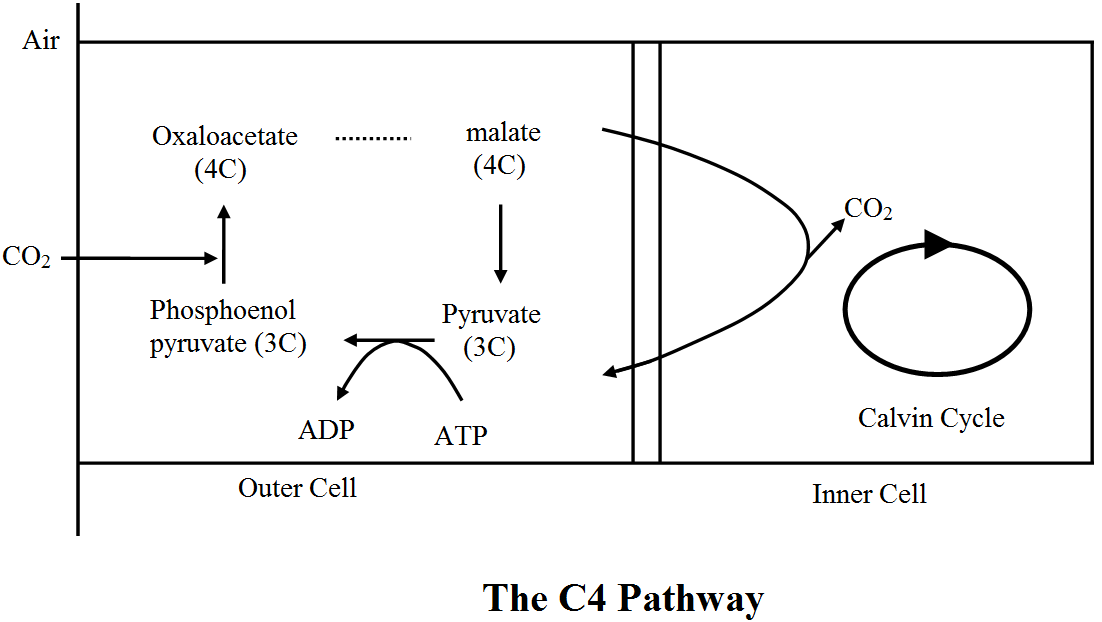
Steps of $C_4$, pathway:
The primary $\mathrm{CO}_2$ acceptor is a 3-carbon molecule phosphoenol pyruvate (PEP) and is present in the mesophyll cells. The enzyme responsible for this fixation is PEP carboxylase or PEPcase. It is important to register that the mesophyll cells lack RuBisCO enzyme. The $\mathrm{C}_4$, acid OAA is formed in the mesophyll cells.
It then forms other 4-carbon compounds like malic acid or aspartic acid in the mesophyll cells itself, which are transported to the bundle sheath cells. In the bundle sheath cells these $\mathrm{C}_4$ acids are broken down to release $\mathrm{CO}_2$ and a 3-carbon molecule.
The 3-carbon molecule is transported back to the mesophyll where it is converted to PEP again, thus, completing the cycle.
The $CO_2$ released in the bundle sheath cells enters the $C_3$ or the Calvin pathway, a pathway common to all plants. The bundle sheath cells are rich in an enzyme Ribulose bisphosphate carboxylase-oxygenase (RuBisco), but lack PEPcase. Thus, the basic pathway that results in the formation of the sugars, the Calvin pathway, is common to the $C_3$ and $C_4$ plants.
Need a full question paper?
Generate a complete, print-ready paper with questions like this in minutes — across 16+ boards, with answer keys.