Question
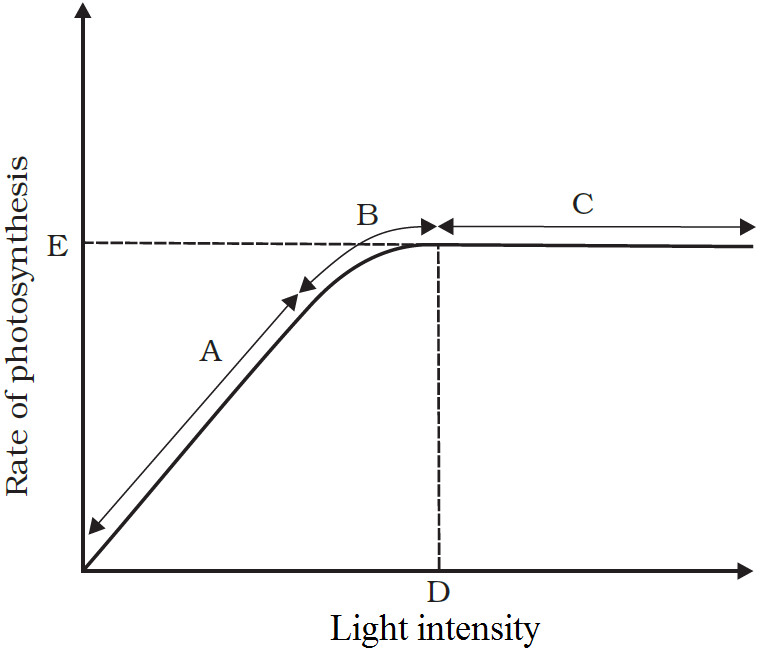
What are the factors which affect photosynthesis? Explain.
The C3 and C4 plants respond differently to CO2 concentrations. At low light conditions neither group responds to high CO2 conditions. At high light intensities, both C3 and C4 plants show increase in the rates of photosynthesis. What is important to note is that C4 the plants show saturation at about
$360\mu\text{IL}^{-1}$ while C3 responds to increased CO2 concentration and saturation is seen only beyond $450\mu\text{IL}^{-1}.$ Thus, current availability of CO2 levels is limiting to the C3 plants. The fact that C3 plants respond to higher CO2 concentration by showing increased rates of photosynthesis leading to higher productivity has been used for some greenhouse crops such as tomatoes and bell pepper. They are allowed to grow in carbon dioxide enriched atmosphere that leads to higher yields.Temperature: The dark reactions being enzymatic are temperature controlled Though the light reactions are also temperature sensitive they are affected to a much lesser extent. The plants respond to higher temperatures and show higher rate of photosynthesis while C3 plants have a much lower temperature optimum.
The temperature optimum for photosynthesis of different plants also depends on the habitat that they are adapted to. Tropical plants have a higher temperature optimum than the plants adapted to temperate climates.
Water: Even though water is one of the reactants in the light reaction, the effect of water as a factor is more through its effect on the plant, rather than directly on photosynthesis. Water stress causes the stomata to close hence reducing the CO2 availability. Besides, water stress also makes leaves wilt, thus, reducing the surface area of the leaves and their metabolic activity as well.
Generate a complete, print-ready paper with questions like this in minutes — across 16+ boards, with answer keys.