Question
What are the functions of an ecosystem?

Answer

The functions of an ecosystem are-
  1. Regulating Function: Maintenance of essential ecological process and life support system.
Explanation: Both biotic and abiotic components live in an ecosystem which interacts with each other forming a stable, self-supporting system.
  1. Energy Flow: The ecosystem act as a buffer through which the flow of energy takes place to all the organisms in the ecosystem.
Explanation: Energy flow in a unidirectional manner starting from sunlight to producers, herbivores, carnivores and finally decomposers thus utilising solar energy to produce chemical energy in the form of glucose by plants which are the main source of energy for all living organisms.
  1. Recycling of nutrients: The ecosystem is responsible for the recycling of the minerals in the biodiversity.
Explanation: The plants take inorganic material from the soil and convert it into food with help of sunlight. The food is used to produce chemical energy by the secondary level organism which breaks them into simple organic compound when the secondary level organism dies it gets decomposed by the action of decomposers which convert the complex substance to simple inorganic substance which are then mixed with soil. Thus, the ecosystem is designed to recycle nutrients.
Need a full question paper?

Generate a complete, print-ready paper with questions like this in minutes — across 16+ boards, with answer keys.

Start Generating Free

Similar questions

An object is placed at a distance of 30cm from a concave lens of focal length 15cm. List four characteristics (nature, position, etc.) of the image formed by the lens.
State the functions of the following hormones:
  1. Thyroxine.
  2. Adrenaline.
  3. Growth hormone.
What is meant by speciation? List four factors that could lead to speciation. Which of these cannot be a major factor in the speciation of a self-pollinating plant species. Give reason to justify your answer.
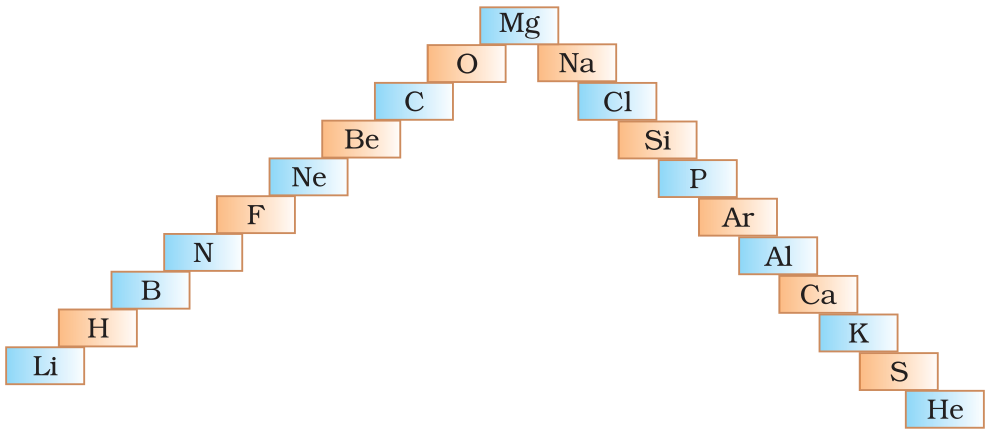
  1. In this ladder (Figure) symbols of elements are jumbled up. Rearrange these symbols of elements in the increasing order of their atomic number in the Periodic Table.
  1. Arrange them in the order of their group also.
An organic compound $A$ with molecular form $C _4 H _8 O _2$ on alkaline hydrolysis gives two compound $B$ and C . C on acidification with dil. HCl gives D. Oxidation of B with $K _2 Cr _2 O _7 / H _2 SO _4$ also gives D. Identify $A , B , C$ and D and explain all the reactions involved.
A metal X forms a salt $XSO _4$. The salt $XSO _4$ forms a clear solution in water which reacts with sodium hydroxide solution to form a blue precipitate Y .
Metal X is used in making electric wire and alloys like brass.
a. What do you think metal $X$ could be?
b. Write the name, formula and colour of salt $XSO _4$.
c. What is the blue precipitate Y ?
d. Write a chemical equation of the reaction which takes place when salt $XSO _4$ reacts with sodium hydroxide solution. Give the state symbols of all the reactants and products which occur in the above equation.
With the help of labelled diagrams, describe an activity to show that acids produce ions only in aqueous solutions.
How can three resistors of resistances 2 Ω, 3 Ω, and 6 Ω be connected to give a total resistance of (a) 4 Ω, (b) 1 Ω?
The organ A which is located inside the skull of our body is protected by a bony shell B. It is surrounded by three layers membranes C. The spaces between these layers are filled with a liquid D which protects organ A from mechanical shocks. Organ A in combination with another organ E makes up the central nervous system.
  1. What is organ A?
  2. What are B, C and D?
  3. Name the organ E.
  4. While walking barefoot, if we happen to step on a sharp piece of stone, we immediately lift our foot up. Which of the two organs: A or E, is directly involved in this action?
  5. If we step out from a darkened room into bright sunlight, we close our eyes for a moment. Which of the two organs: A or E, is directly involved in this action?
Energy from various sources is considered to have been derived from the sun. Do you agree? Justify your answer.