What are the New sources of threats at the international level? Describe them incorporating current context.
[BOARD SAMPLE PAPER 2025-26]
Download our app for free and get started
New Sources of Threats
These threats are "non-traditional" because they are often transnational (crossing borders) and cannot be solved by a single country's military alone.
1. Terrorism
- Definition: Terrorism refers to political violence that targets civilians deliberately and indiscriminately to create a sense of fear.
- Current Context: While the textbook cites the 9/11 attacks as a classic example, modern terrorism has evolved into Cyber-Terrorism. Groups now target a country’s digital infrastructure, such as banking systems and power grids, which can be as devastating as physical bombs.
2. Human Rights
- Definition: The violation of fundamental rights (political, economic, and social) is now seen as a global threat.
- Current Context: There is ongoing international debate over when the UN should intervene. For instance, mass killings or ethnic cleansing (as seen historically in Rwanda or more recently in various global "hotspots") create regional instability and humanitarian crises that threaten global peace.
3. Global Poverty
- Definition: The massive economic disparity between the developed "North" and the developing "South."
- Current Context: Poverty acts as a "silent killer." High population growth in poor regions (like Sub-Saharan Africa) leads to competition for scarce resources. This often results in armed conflicts or provides a breeding ground for extremist ideologies.
4. Migration and Refugees
Definition: Large-scale movement of people across borders due to war, natural disasters, or lack of economic opportunity.
Current Context: Refugees are those forced to flee (e.g., due to conflicts in Ukraine or Syria).
- Migrants move voluntarily for better lives. This creates tension in host countries over jobs and resources, making it a major international political issue today.
5. Health Epidemics
- Definition: Infectious diseases that spread rapidly across borders due to increased global travel, trade, and tourism.
- Current Context: The COVID-19 pandemic is the most significant modern example. It proved that a virus can cause more deaths and economic damage than a traditional war. Other examples mentioned in the syllabus include HIV/AIDS, Ebola, and SARS. These threats require "Cooperative Security" rather than military force.
6. Environmental Degradation
- Definition: Threats like global warming, ozone depletion, and water scarcity that affect the entire planet.
- Current Context: Climate change is now considered an existential threat. Rising sea levels could submerge island nations, creating millions of "environmental refugees" and potentially leading to "water wars" between countries sharing the same rivers.
These threats are "non-traditional" because they are often transnational (crossing borders) and cannot be solved by a single country's military alone.
1. Terrorism
- Definition: Terrorism refers to political violence that targets civilians deliberately and indiscriminately to create a sense of fear.
- Current Context: While the textbook cites the 9/11 attacks as a classic example, modern terrorism has evolved into Cyber-Terrorism. Groups now target a country’s digital infrastructure, such as banking systems and power grids, which can be as devastating as physical bombs.
2. Human Rights
- Definition: The violation of fundamental rights (political, economic, and social) is now seen as a global threat.
- Current Context: There is ongoing international debate over when the UN should intervene. For instance, mass killings or ethnic cleansing (as seen historically in Rwanda or more recently in various global "hotspots") create regional instability and humanitarian crises that threaten global peace.
3. Global Poverty
- Definition: The massive economic disparity between the developed "North" and the developing "South."
- Current Context: Poverty acts as a "silent killer." High population growth in poor regions (like Sub-Saharan Africa) leads to competition for scarce resources. This often results in armed conflicts or provides a breeding ground for extremist ideologies.
4. Migration and Refugees
Definition: Large-scale movement of people across borders due to war, natural disasters, or lack of economic opportunity.
Current Context: Refugees are those forced to flee (e.g., due to conflicts in Ukraine or Syria).
- Migrants move voluntarily for better lives. This creates tension in host countries over jobs and resources, making it a major international political issue today.
5. Health Epidemics
- Definition: Infectious diseases that spread rapidly across borders due to increased global travel, trade, and tourism.
- Current Context: The COVID-19 pandemic is the most significant modern example. It proved that a virus can cause more deaths and economic damage than a traditional war. Other examples mentioned in the syllabus include HIV/AIDS, Ebola, and SARS. These threats require "Cooperative Security" rather than military force.
6. Environmental Degradation
- Definition: Threats like global warming, ozone depletion, and water scarcity that affect the entire planet.
- Current Context: Climate change is now considered an existential threat. Rising sea levels could submerge island nations, creating millions of "environmental refugees" and potentially leading to "water wars" between countries sharing the same rivers.

Download our appand get started for free
Experience the future of education. Simply download our apps or reach out to us for more information. Let's shape the future of learning together!No signup needed.*
Similar Questions
- 1View SolutionExplain in brief any four components of India's security strategy.
- 2View SolutionDescribe any three new sources of threat to security giving examples for each.
- 3View SolutionRead the passage given below carefully and answer the questions that follow:
All proponents of human security agree that its primary goal is the protection of individuals. However, there are differences about precisely what threats individuals should be protected from. Proponents of the ‘narrow’ concept of human security focus on violent threats to individuals.- Which type of security is the main concern of ‘human security’?
- What would you like to include under the ‘broad’ concept of human security? Explain.
- Identify any four threats from which individuals should be protected.
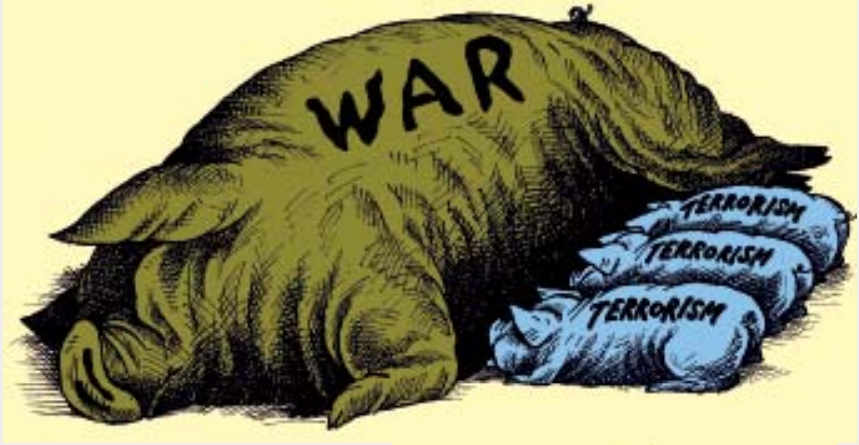
- 4View SolutionRead the cartoon below and write a short note in favour or against the connection between war and terrorism depicted in this cartoon.
- 5View Solution
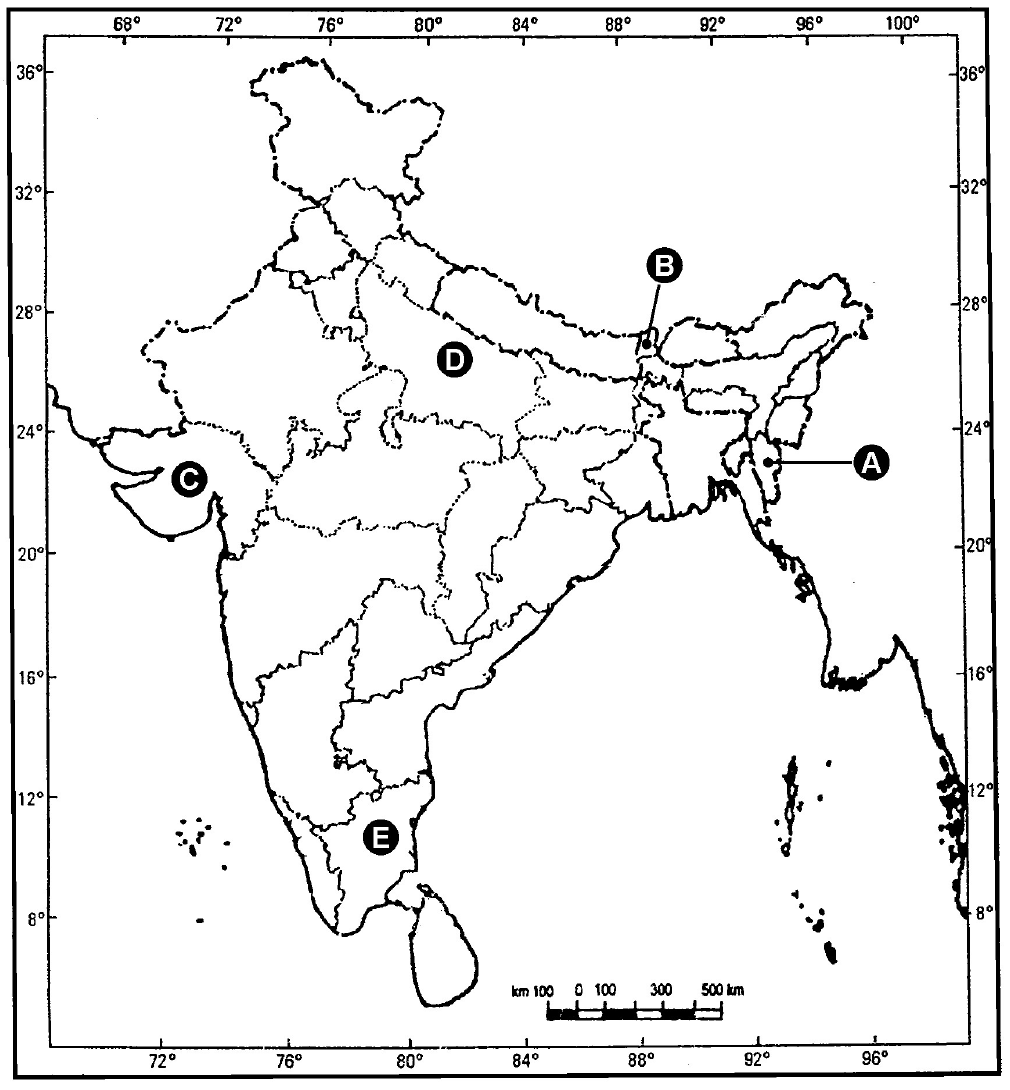
In the political outline map of India given above, five states have been marked as $\text{A, B, C, D}$ and $E.$ Identify these states on the basis of information given below and write their correct names in your answer book along with the respective serial number of the information used and the concerned alphabet in the map as per the following format.Sr. No. of the information usedConcerned alphabet in the MapName of the State$i.$ $ii.$ $iii.$ $iv.$ $v.$ - The state where a violent incident took place at Godhara in $2002.$
- The state which was earlier known as Madras.
- The state which has the maximum number of seats in India in its Legislative Assembly.
- The state to which Laldenga belonged.
- The state which integrated with India in $1975$ as $22^{nd}$ State of India.
- 6View SolutionWhat is meant by Security? Mention any four components of Indian security strategy.
- 7View SolutionExplain any four economic consequences of globalisation.
- 8View SolutionWhat is meant by global poverty? Suggest any two ways to reduce disparity between the poor and the rich at the global level.
- 9View SolutionStudy the following passage carefully and answer the questions that follow:
The lack of genuine international support for democratic rule in Pakistan has further encouraged the military to continue its dominance. The United States and other Western countries have encouraged the military’s authoritarian rule in the past, for their own reasons. Given their fear of the threat of what they call ‘global Islamic terrorism’ and the apprehension that Pakistan’s nuclear arsenal might fall into the hands of these terrorist groups, the military regime in Pakistan has been seen as the protector of Western interests in West Asia and South Asia.- What is meant by ‘global Islamic terrorism’?
- Why did Pakistan lack genuine international support for democratic rule?
- Why was the military regime in Pakistan considered as the protector of Western interests in West Asia and South Asia?
- 10View SolutionWhat are the objectives of military alliances? Give an example of a functioning military alliance with its specific objectives.