Question
What are the problems faced by India owing to the ‘population explosion’?

Answer

Consequences of ‘population explosion’ in India:
  1. Scarcity of food, space and water: Although the population is growing rapidly the living and food, space, production available per person has remained constant.
  2. Increase in epidemics a (id diseases as a result of unhygenic and crowded living conditions in cities, towns and villages.
  3. Unemployment and poverty will be uncontrollable and may lead to social unrest and lack of educational facilities.
  4. Destruction of forests and their fauna and flora so that more land can be brought under cultivation or for human dwellings.
  5. Problems of sanitation, cleanliness and clean drinking water for the increasing population.
  6. Lack of facilities such as schools, colleges, hospitals, transportation, etc.
  7. Non-renewable resources such as coal, oil, water, minerals, etc., will be consumed very quickly.
  8. Disturbances in ecological balance due to deforestation and pollution.

Need a full question paper?

Generate a complete, print-ready paper with questions like this in minutes — across 16+ boards, with answer keys.
Start Generating Free

Similar questions

List the advantages of having small families.
Describe an experiment to prove that transpiration occurs more from the lower surface of a leaf.
How is root hair adapted for the absorption of water from the soil?
Discuss in detail the process of ozone depletion.
Describe the mechanism of focusing the image of a distant object in your eye when you raise your head after reading a book.
What are the main steps in coagulation of blood?
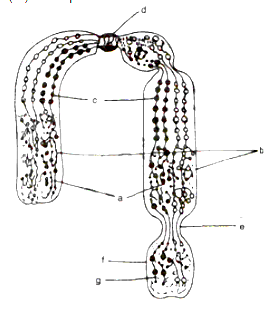
Label the lettered parts of the given figure and answer the following questions:
(i) What does this diagram represent?
(ii) What is the importance of'd'?
(iii) What are the 'staining' properties of 'b' and 'c'?
(iv) Who gave the term used for this structure today?
(v) What is a?
(vi) Is 'e' present in all chromosomes?
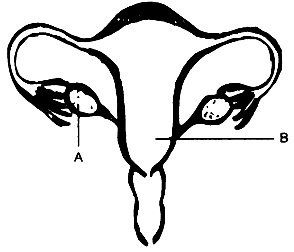
Study the diagram given below and then answer the questions that follow:

(i) Name the part labeled A. Name any two hormones produced by the part labeled A.
(ii) What happens to the part labeled B.
(1) if fertilization takes place?
(2) If fertilization does not take place?
(iii) Where does fertilization occur?
(iv) Draw a neat diagram of the human sperm as seen under high magnification and label the following parts.
(1) Acrosome
(2) Mitochondria
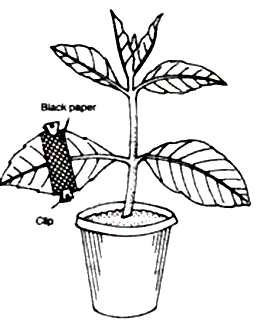
The diagram alongside represents an experiment conducted to prove the importance of a factor in photosynthesis.

Study the same and then answer the questions that follow:
(i) Name the factor being studied in his experiment.
(ii) Why was the plant kept in a dark room before conducting the experiment?
(iii}Why was the experimental leaf then kept in
1. boiling water 2. methylated spirit?
(iv) Name the solution used to test for the presence of starch in the leaf.
(v) What will we observe in the experimental leaf at the end of the starch test?
(vi) Give a balanced chemical equation to represent the process of photosynthesis.
Column ‘II’ is a list of items related to ideas in Column ‘I’. Match the term in Column ‘II’ with a suitable idea given in Column ‘I’.
Column IColumn II
(i) Acrosome
(ii) Ovulation
(iii) Sperm
(iv) Menopause
(v) Implantation>
(vi) Fertilization
(vii) Contraception in males
(a) Male gamete
(b) Oviduct
(c) Uterus
(d) Spermatozoa
(e) Progesterone
(f) Stoppage of the menstrual cycle
(g) Sudden change in genes