MCQ
What are the products form at anode during Kolbe synthesis
- AHydrocarbons
- B$CO_2$
- ✓Both
- DNone
Kolbe reaction is formally a decarboxylative dimerisation of two carboxylic acids (or carboxylate ions) The overall general reaction is as shown in an image.
After electrolysis alkane is formed at anode along with the release of carbon-dioxide. When potassium acetate $\left(\mathrm{CH}_{3} \mathrm{COO}^{-} \mathrm{K}^{+}\right)$ is used in electrolysis, carbon dioxide is released
along with ethane $\left(\mathrm{H}_{3} \mathrm{C}-\mathrm{CH}_{3}\right)$
$\mathrm{CH}_{3} \mathrm{COO}^{-} \longrightarrow \mathrm{CH}_{3}($ radical $)+\mathrm{CO}_{2}$
$\mathrm{CH}_{3}($ radical $)+\mathrm{CH}_{3}($ radical $) \longrightarrow \mathrm{C}_{2} \mathrm{H}_{6}($ ethane $)$ is release at anode.
Option C is the correct answer.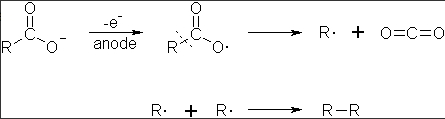
Generate a complete, print-ready paper with questions like this in minutes — across 16+ boards, with answer keys.
$X$ is
$(a)$ Heat of combustion reaction
$(b)$ Heat of formation reaction
$(c)$ An exothermic reaction
$(d)$ Not neutralization reaction