Question
What are the reasons for biodiversity conservation?

Answer

Reasons for Biodiversity Conservation:There are three main reasons for conserving the biodiversity which have been classified into the following categories:
  1. Narrowly utilitarian arguments:
  • Human beings derive direct economic benefits from nature, like food, firewood, fibre, construction material, industrial products (resins, gums, dyes, tannins, etc.) and medicinally important products.
  • • More than 25 percent of the drugs are derived from plants and about 25,000 species of plants are used by native people as traditional medicines.
  1. Broadly utilitarian arguments:
  • Biodiversity plays a major role in maintaining and sustaining supply of goods and services from various species as well as ecological systems.
  • The different ecological services provided are:
  1. Amazon forest is estimated to contribute 20 percent of the total oxygen in the atmosphere on earth.
  2. Ecosystem provides pollinators like bees, bumble bees, birds and bats which pollinate plants to form fruits and seeds.
  1. Ethical reasons:
  • There are thousands of plants, animals and microbes on this earth which are not useless. Every one has some intrinsic value even if it is not of any economic value to us.
  • It is, therefore, our moral duty to ensure well-being of all the living creatures for the utilisation of future generations.

Need a full question paper?

Generate a complete, print-ready paper with questions like this in minutes — across 16+ boards, with answer keys.
Start Generating Free

Similar questions

More than 25% of human population is suffering from hunger and malnutrition. Scientists have developed techniques where microbes are grown on industrial scale as a source of good protein which can be grown from waste water, animal manure and even sewage.
Based on the above information answer the following questions.
  1. In what ways would it be helpful to humans?
  2. What can be the response to such new ventures?
  3. What values have been manifested in the above case?
Answer the following questions:
With labelled diagrams, depict stages in embryo development in a dicotyledenous plant.
Describe in detail the steps involved in the replication of DNA.
  1. Comment on the pattern in which all communities undergo a change in composition and structure with changing environmental conditions.
  2. Explain 'climax community' and 'sere'.
  3. Differentiate between primary and secondary Succession, with examples.
Ranjana and Shilpi had a hot argument whether or not life is still originating on the earth today. Their neighbour, Mr. Kamal Mishra, a retired professor, who happened to be listening to the girls, called them and explained the matter in detail.
  1. As a student of biology, what is your answer to the above problem? And why?
  2. Recall the experiment of Miller, which simulated the primitive atmosphere.
  1. What were the products obtained in his experiment?
  2. How was energy provided in the experiment?
  1. What would have been the energy source for origin of life on the earth?
  2. Indicate the values shown by Mr. Kamal Mishra?
Study the flow chart given below and answer the questions that follow:
  1. S strain into mice mice die.
  2. R strain into mice → mice live.
  3. Heat killed S strain + live R strain into mice → A
  4. Heat killed S strain + DNase + live R strain → into mice B
  1. Name the organism and differentiate between its two strains, R and S, respectively.
  2. Write the results A and B obtained in steps (e) and (d), respectively.
  3. Name the Scientist who performed the steps (a), (b) and (c).
  4. Write the specific conclusion drawn from the step (d).
Describe in detail the development of male gametophyte in angiosperms with well labelled diagram.
You have a friend whose parents are too indulgent in his/her daily affairs. They think him/her to be still young which makes him/her sad and is upset all the time. As he/she feels that the parents should give him/her opportunity to take independent decision on some issues.
  1. Would you support your friend and why?
  2. Write the characteristics of this age group.
  3. List two curative measures.
List the characteristics of the disorders mentioned above that help in their diagnosis.
Read the following and answer any four questions from (i) to (v) given below:
Gene therapy is the technique of genetic engineering to replace a faulty gene by a normal healthy functional gene. It is a way of treating genetic disease by introducing a piece of DNA into the cells of an affected individual. Liposomes can be used for gene therapy as they target the cells affected by a genetic disease.
  1. A patient suffers from adenosine deaminase (ADA) deficiency, an autosomal recessive immune deficiency in which bone marrow lymphoblasts cannot replicate to generate immuno-competent lymphocytes. The treatment option that would cure the patient is:
  1. Germ-line gene therapy to replace one ADA gene copy.
  2. Germ-line gene therapy to replace both ADA gene copies.
  3. Somatic cell gene therapy to replace both ADA gene copies in circulating lymphocytes.
  4. Somatic cell gene therapy to replace one ADA gene copy in bone marrow lymphoblasts.
  1. Which type of gene therapy is least effective in transferring DNA to the nucleus?
  1. Adenoviruses.
  2. DNA attached to a ligand.
  3. Liposomes.
  4. Retroviruses.
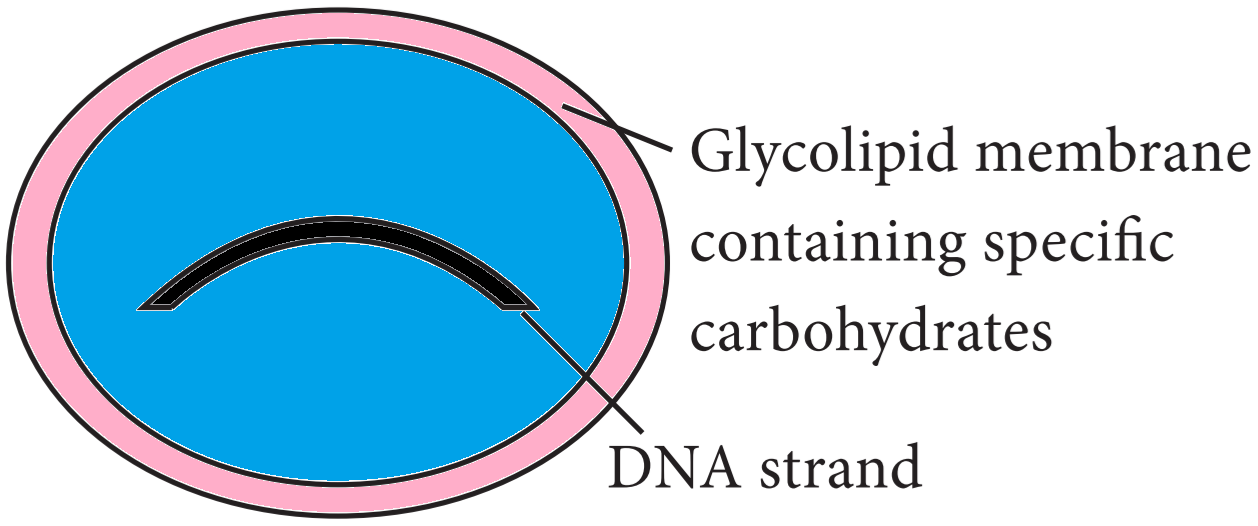
  1. Liposomes can be used for gene therapy as they target the cells affected by a genetic disease. The diagram shows the structure of a liposome.


What feature of a cell surface membrane allows the liposome to target cells affected by a genetic disease?
  1. Carrier molecules.
  2. Phosphate groups.
  3. Protein channels.
  4. Receptor molecules.
  1. Which of the following disorders would gene therapy be least effective?
  1. Cystic fibrosis.
  2. Huntington's disease.
  3. Sickle cell anaemia.
  4. Type II diabetes.
  1. Following are some reasons explaining why gene therapy is not yet fully an effective treatment for genetic diseases.
  1. Lack of knowledge of DNA sequences.
  2. Lack of efficient and safe gene delivery system.
  3. Cost of the technology.
  4. Some diseases involve multiple genes.
  5. Problems with appropriate gene regulation.
Select the correct option.
  1. I, III and V only
  2. II, IV and V only
  3. Ill, IV and V only
  4. I, III and IV only