Question
What are the rules for finding the significant figures? Explain each rule with an example.
Answer

self

Need a full question paper?

Generate a complete, print-ready paper with questions like this in minutes — across 16+ boards, with answer keys.

Start Generating Free

Similar questions

An object of mass m is raised from the surface of the earth to a height equal to the radius of the earth, that is, taken from a distance R to 2R from the centre of the earth. What is the gain in its potential energy?
A wire of length L and radius r is clamped rigidly at one end. When the other end of the wire is pulled by a force f, its length increases by l. Another wire of the same material of length 2L and radius 2r, is pulled by a force 2f. Find the increase in length of this wire.
Glycerine flows steadily through a horizontal tube of length 1.5 m and radius 1.0 cm . If the amount of glycerine collected per second at one end is $4.0 \times 10^{-3} \mathrm{~kg} \mathrm{~s}^{-1}$, what is the pressure difference between the two ends of the tube? (Density of glycerine $=1.3 \times 103 \mathrm{~kg} \mathrm{~m}^{-3}$ and viscosity of glycerine $=0.83 \mathrm{~Pa}$ ). [You may also like to check if the assumption of laminar flow in the tube is correct].
A satellite is in an elliptic orbit around the earth with aphelion of $6R$ and perihelion of $2R$ where $R = 6400km$ is the radius of the earth. Find eccentricity of the orbit. Find the velocity of the satellite at apogee and perigee. What should be done if this satellite has to be transferred to a circular orbit of radius $6R$?$[G = 6.67 \times 10^{–11} SI$ units and $M = 6 \times 10^{24}kg]$
Estimate the average thermal energy of a helium atom at:
  1. Room temperature $(27°C)$
  2. The temperature on the surface of the Sun(6000K)
  3. The temperature of 10 million kelvin (the typical core temperature in the case of a star).
The electrical resistance in ohms of a certain thermometer varies with temperature according to the approximate law:
$\text{R}=\text{R}_0[1+\alpha(\text{T}-\text{T}_0)]$
The resistance is $101.6W$ at the triple-point of water $273.16K$, and $165.5W$ at the normal melting point of lead $(600.5K)$. What is the temperature when the resistance is $123.4W$?
A brass rod of length $50$ cm and diameter $3.0$ mm is joined to a steel rod of the same length and diameter. What is the change in length of the combined rod at $250^{\circ} \mathrm{C}$, if the original lengths are at $40.0^{\circ} \mathrm{C}$ ? Is there a 'thermal stress' developed at the junction? The ends of the rod are free to expand (Co-efficient of linear expansion of brass $=2.0 \times$ $10^{-5} \mathrm{~K}^{-1}$, steel $\left.=1.2 \times 10^{-5} \mathrm{~K}^{-1}\right)$.
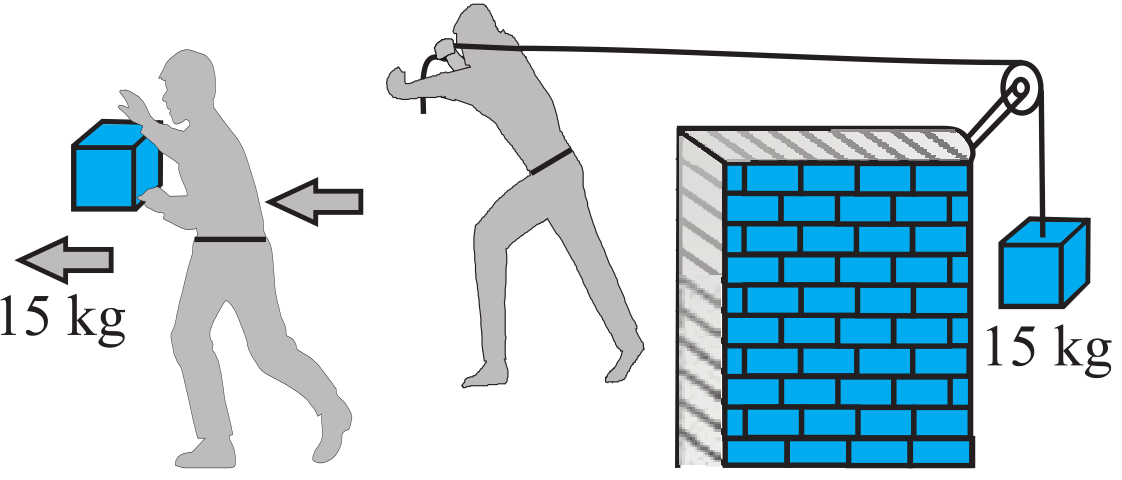
Answer the following: In the man walks $2m$ carrying a mass of $15kg$ on his hands. In he walks the same distance pulling the rope behind him. The rope goes over a pulley, and a mass of $15kg$ hangs at its other end. In which case is the work done greater?
Add vectors $\overrightarrow{\text{A}},\overrightarrow{\text{B}}$ and $\overrightarrow{\text{C}}$ each having magnitude of 100 unit and inclined to the X-axis at angles 45°, 135° and 315° respectively.
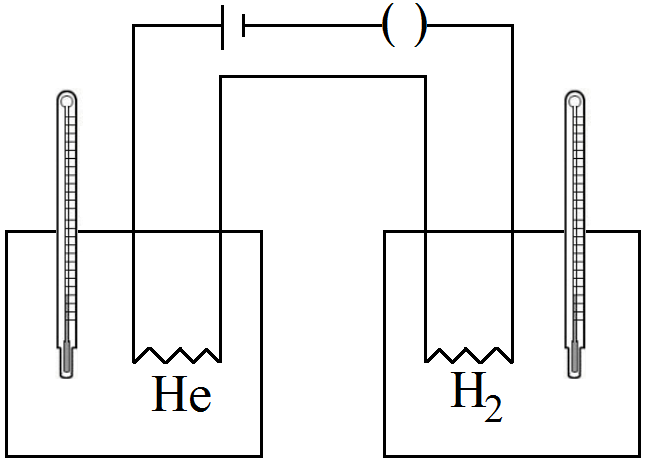
The figure shows two vessels with adiabatic walls, one containing 0.1g of helium $\big(\gamma=1.67,\text{M}=4\text{g-mol}^{-1}\big)$ and the other containing some amount of hydrogen $\big(\gamma=1.4,\text{M}=2\text{g-mol}^{-1}\big).$ Initially, the temperatures of the two gases are equal. The gases are electrically heated for some time during which equal amounts of heat are given to the two gases. It is found that the temperatures rise through the same amount in the two vessels. Calculate the mass of hydrogen.