Question
What are the two basic characteristics of a simple harmonic motion?

Answer

The two basic characteristics of a simple harmonic motion:
  1. Acceleration is directly proportional to displacement.
  2. The direction of acceleration is always towards the mean position, that is opposite to displacement.

Need a full question paper?

Generate a complete, print-ready paper with questions like this in minutes — across 16+ boards, with answer keys.
Start Generating Free

Similar questions

When blown between two light balls hanging near each other, they are attracted towards each other why?
Write the factors affecting surface tension?
A wire of length 2.5m has a percentage strain of 0.012% under a tensile force. Determine the extension in the wire.
The design of some physical instrument requires that there be a constant difference in length of 10cm between an iron rod and copper rod laid side by side at all temperatures. Find their lengths.
$\alpha_{\text{Fe}}=11\times10^{-6}\ ^\circ\text{C}^{-1},$
$\alpha_{\text{Cu}}=17\times10^{-6}\ ^\circ\text{C}^{-1}.$
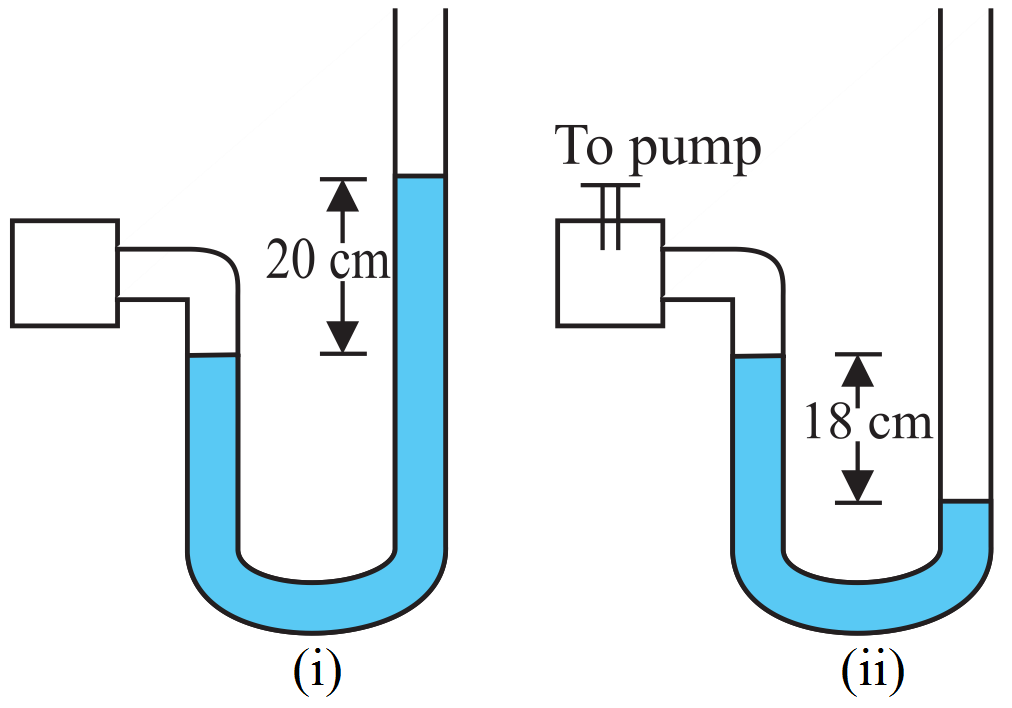
A manometer reads the pressure of a gas in an enclosure as shown in Fig.(a) When a pump removes some of the gas, the manometer reads as in Fig. (b) The liquid used in the manometers is mercury and the atmospheric pressure is 76cm of mercury.
Give the absolute and gauge pressure of the gas in the enclosure for cases (i) and (ii) in units of cm of mercury.
How would the levels change in case (i) if 13.6cm of water (immiscible with mercury) are poured into the right limb of the manometer? (Ignore the small change in volume of the gas.)

The SI unit of energy is $J = kg m ^2 s ^{-2}$; that of speed $v$ is $m s ^{-1}$ and of acceleration $a$ is $m s ^{-2}$. Which of the formulae for kinetic energy ( $K$ ) given below can you rule out on the basis of dimensional arguments ( $m$ stands for the mass of the body) :
(a) $K=m^2 v^3$
(b) $K=(1 / 2) m v^2$
(c) $K=m a$
(d) $K=(3 / 16) mv ^2$
(e) $K=(1 / 2) m v^2+m a$
A boy puts a heavy box of mass M on his head and jumps down from the top of a multistoried building to the ground. How much is the force exerted by the box on his head during his free fall? Does the force greatly increase during the period he balances himself after striking the ground?
If force F, length L and time T are taken as fundamental units then what be the dimensions of mass?
What is an isothermal process? Also give essential conditions for an isothermal process to take place.
A non-ideal battery is connected to a resistor. Is work done by the battery equal to the thermal energy developed in the resistor? Will your answer change if the battery is ideal?