Question
What are types of Accounting?

Answer

Types of Accounting:
  1. Financial Accounting: The main purpose of this branch of account ng is to record the business transactions in a systematic manner, to ascertain the profit or loss of the account ng period by preparing a Profit & Loss Account and to present the financial posit on of the business by preparing a Balance Sheet. This branch of accounting provides informations required by the management and various other interested parties.
  2. Cost Accounting: The main purpose of cost accounting is to ascertain the total cost and per unit cost of goods produced and services rendered by a bus ness. It also estimates the cost in advance and helps the management in exercising strict control over cost.
  3. Management Accounting: The main purpose of management accounting is to present the accounting information in such a way as to assist the management in planning and controlling the operations of a business. The management accountant uses various techniques and concepts to make the accounting data more useful for managerial decision making. These techniques include ratio analysis, budgetary control, fund flow statement, cash flow statement etc.
  4. Tax Accounting: The branch of accounting which is used for tax purposes is called Tax Accounting. Income tax and GST are computed on the basis of this accounting.
  5. Social responsibility Accounting: The society provides the infrastructure and the facilities without which business cannot operate at all. Hence the business also has a responsibility to the society. There is a growing demand for reports on activities which reflect the contribution of an enterprise to the society. Social responsibility accounting is the process of identifying, measuring and communicating the contribution of a business to the society. The contribution of a business to the society consist of providing employment to under-privileged, providing financial and manpower support for public programs, environmental contribution, product safety, product durability, customer satisfaction etc. In social responsibility accounting techniques have been developed for measuring the cost of these contributions and the benefit to the society.

Need a full question paper?

Generate a complete, print-ready paper with questions like this in minutes — across 16+ boards, with answer keys.

Start Generating Free

Similar questions

Enter the following transactions in the 'Journal Proper' of Karuna Stores:
March 1 Purchased furniture on credit from Kuber Furniture Store for ₹ 15,000.
March 5 Goods for ₹ 6,000 given away as charity.
March 12 Goods worth ₹ 8,000 and Cash ₹ 4,000 were stolen by an employee.
March 15 Arun who owed us ₹ 20,000 was declared insolvent and nothing was received from him.
March 18 Proprietor withdrew for his personal use cash ₹ 5,000 and goods worth ₹ 10,000.
March 31 Provide interest on capital of ₹ 5,00,000 at 6% p.a. for full year.
March 31 Out of the rent paid this year, ₹ 5,000 is related to the next year.
March 31 Salaries due to clerks ₹ 12,000.
Ravi sold goods for ₹ 40,000 to Sudershan on Feb 13, 2016. He drew four bills of exchange upon Sudershan. The first bill was for ₹ 5,000 payable after one month. The second bill was for ₹ 10,000 payable after 40 days; the third bill was for ₹ 12,000 payable after three months and fourth bill was for the balance amount payable after 19 days. Sudershan accepted all the bills and returned the same to Ravi. Ravi discounted the first bill with his bank at 6% p.a. He endorsed the second bill to his creditor Mustaq for the full settlement of a debt of ₹ 10,200. The third bill was kept by Ravi with him till the date of maturity. Five days before the maturity of the fourth bill, Ravi sent the bill to his bank for collection. All the four bills were dishounoured by Sudarshan on maturity. Sudershan settled Ravi’s claim in cash three days after the dishonour of each bill along with interest @ 12% p.a. for the terms of the bills. You are requested to record the necessary journal entries in the books to Ravi, Sudershan, Mustaq and bank for the above transaction. Also prepare Sudershan’s account and Mustaq’s account in the books of Ravi.
While trying to close his books for the year ended 31st March, 2023, Mandeep found that the trial balance did not agree. He traced the following errors:
i. The Purchases Book was undercast by ₹ 500 .
ii. The Sales Book was overcast by ₹ 100 .
iii. ₹ 620 received from Manoj were posted to the debit of his $A / c$.
iv. The total of the credit of Bhanu's A/c has been over added by ₹ 800 .
v. A discount of ₹ 282 allowed to a customer has been credited to his account as ₹ 228.
vi. Goods for ₹ 1,200 returned to Kartik Sharma, though entered in the Return Book has not been posted to his account.
Rectify the above errors, assuming:
A. that no suspense account has been opened with the difference in the trial balance,
B. that such a suspense account has been opened.
X Ltd. purchased a plant on 1st July, 2010 costing ₹ 5,00,000. It purchased another plant on 1st September, 2010 costing ₹ 3,00,000. On 31st December, 2012, the plant purchased on 1st July, 2010 got out of order and was sold for ₹ 2,15,000. Another plant was purchased to replace the same for ₹ 6,00,000. Depreciation is to be provided at 20% p.a. according to Writen Down Value Method. The accounts are closed every year on 31st March.
Show the Plant Account and Provision for Depreciation Account.
Asha sold goods worth ₹ 19,000 to Nisha on March 02, 2017. ₹ 4,000 were paid by Nisha immediately and for the balance she accepted a bill of exchange drawn upon her by Asha payable after three months. Asha discounted the bill immediately with her bank. On the due date Nisha dishonoured the bill and the bank paid ₹ 30 as noting charges. Record the necessary journal entries in the books of Asha and Nisha.
On 30th June 2014, the Cash Book of a trader shows a bank overdraft of ₹ 2,500. Following informations are available:-
  1. Cheques amounting to ₹ 14,600 had been paid to the bank, but of these only ₹ 12,200 were credited in the Pass Book, up to 30th June, 2014.
  2. He had also issued cheques amounting to ₹ 10,000, out of which only ₹ 3,600 had been presented for payment.
  3. A cheque of ₹ 500 which he had debited to the bank account was not sent to bank for collection by mistake.
  4. There is a debit in the Pass Book of ₹ 10 for Bank Charges and ₹ 50 for interest.
  5. A customer directly paid into his bank ₹ 1,000, but it was not shown in the Cash Book.
  6. Bank has paid insurance premium of ₹ 400 according to his instructions, but this is not recorded in the Cash Book.
Prepare a Bank Reconciliation Statement.
Explain the business entity concept with example.
Rectify the following entries assuming that the narration in each case is correct:
A sold goods to B on 1st September, 2018 for ₹ 16,000. B immediately accepted a 3 months bill. On the due date, B requested that the bill be renewed for a further period of 2 months. A agreed provided interest at 9% p.a. was paid immediately in cash. To this Bwas agreeable. The second bill was met on the due date. Give the Journal entries in the books of A.
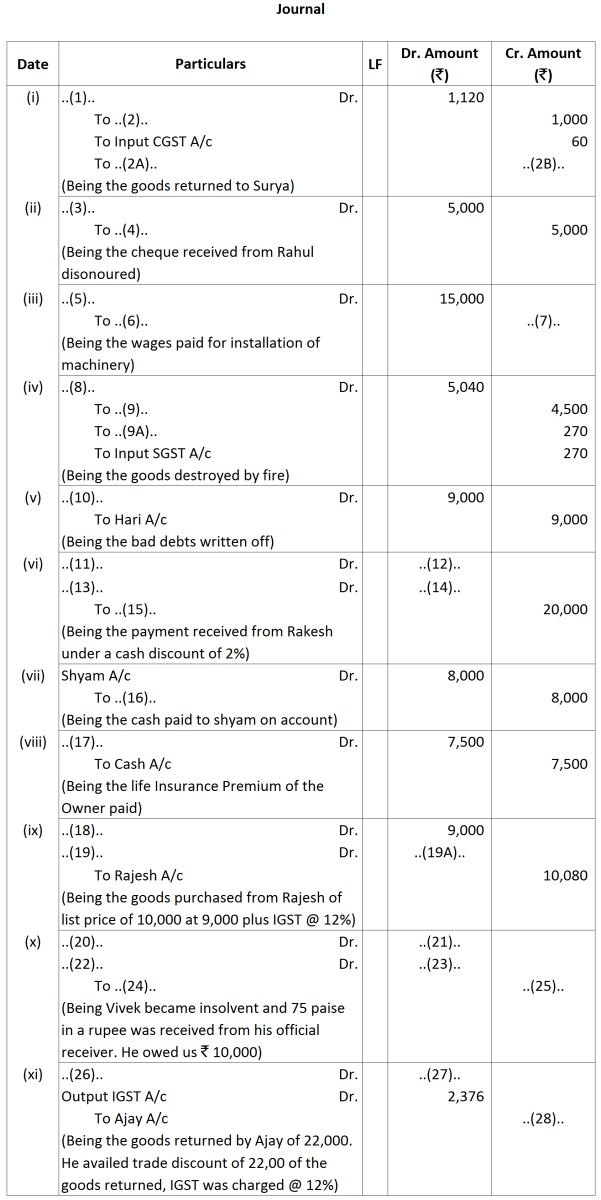
Fill in the missing values on the basis of narration: