Question
What are vitamin compounds? Give primary information about vitamin compounds.

Answer

"It has been observed that certain organic compounds are required in small amounts in our diet but their deficiency causes specific diseases. These compounds are called vitamins."
Most of the vitamins can not be synthesised in our body but plants can synthesise almost all of them.
So, they are considered as essential food factors.
However, the bacteria of the gut can produce some of the vitamins required by us.
All the vitamins are generally available in our diet.
Different vitamins belong to various chemical classes and it is difficult to define them on the basis of structure.
They are generally regarded as organic compounds required in the diet in small amounts to perform specific biological functions for normal maintenance of optimum growth and health of the organism.
Vitamins are designated by alphabets A, B, C, D, etc.
Some of them are further named as sub-groups e.g. $B_1, B_2, B_6, B_{12}$ etc.
The term "Vitamine" was coined from the word vital + amine since, the earlier identified compounds had amino groups. Later work showed that most of them did not contain amino groups, so the letter 'e' was dropped and the term 'vitamin' is used these days.

Need a full question paper?

Generate a complete, print-ready paper with questions like this in minutes — across 16+ boards, with answer keys.
Start Generating Free

Similar questions

An organic compound ' $A$ ' $\left(\mathrm{C}_3 \mathrm{H}_4\right)$ on hydration in presence of $\mathrm{H}_2 \mathrm{SO}_4 / \mathrm{HgSO}_4$ gives compound '$B$' $\left(\mathrm{C}_3 \mathrm{H}_6 \mathrm{O}\right)$. Compound 'B' gives white crystalline product ( D ) with sodium hydrogensulphite. It gives negative Tollens' test and positive iodoform's test. On drastic oxidation 'B' gives compound ' $\mathrm{C}^{\prime}\left(\mathrm{C}_2 \mathrm{H}_4 \mathrm{O}_2\right)$ along with formic acid. Identify compounds ' A ', ' B ' and ' C ' and explain all the reactions.
Explain the following: $H_3PO_3$ is diprotic.
Answer thefollowing:
  1. Haloalkanes easily dissolve in organic solvents,why?
  2. What is known as a racemic mixture? Give an example.
  3. Of the two bromoderivatives, $C_6H_5CH(CH_3)Br$ and $C_6H_5CH(C_6H_5) Br$, which one ismore reactive in $S_N1$ substitution reaction and why?
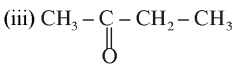
Give the products of following carbonyl compounds when oxidised with acidic $KMnO _4$ or acidic $K _2 Cr _2 O _7$.
(i) $CH _3 CHO$
(ii) $CH _3 COCH _3$
Image
Give two reactions that show the acidic nature of phenol. Compare acidity of phenol with that of ethanol.
  1. Which one of the following is a disaccharide: starch, maltose, fructose, glucose
  2. What is the difference between acidic amino acid and basic amino acid?
  3. Write the name of the linkage joining two nucleotides.
  1. Using valence bond theory predict the geometry and magnetic behaviour of $[Cr(NH_3)_6]^{3+}ion[Cr=24].$
  2. Write IUPAC name of:
$[Pt(NH_3)_2Cl_2].$
Give primary information about carbohydrate compounds?
Write the structures of the monomers used for getting the following polymers :
  1. Polyvinyl chloride (PVC)
  2. Melamine formaldehyde polymer
  3. Buna-N
Write the chemical reactions involved in the extraction of gold by cyanide process. Also give the role of zinc in the extraction.