MCQ
What causes chromatic aberration?
- AMarginal rays
- BCentral rays
- CDifference in radii of curvature of its surfaces
- DVariation of focal length of lens with colour
What causes chromatic aberration?
Explanation:
Chromatic aberration occurs when a lens is either unable to bring all wavelengths of color to the same focal plane and/or wavelengths of color are focused at different positions in the focal plane.
Generate a complete, print-ready paper with questions like this in minutes — across 16+ boards, with answer keys.
X-rays are not used for radar purpose because
| (a) They are not reflected by the target |
| (b) They are not electromagnetic waves |
| (c) They are completely absorbed by the air |
| (d) They sometimes damage the target |
There long straight wires A, B and C are carrying current as shown figure. Then the resultant force on B is directed .....
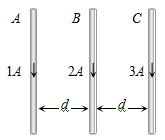
|
(a) Towards A |
|
(b) Towards C |
|
(c) Perpendicular to the plane of paper and outward |
|
(d) Perpendicular to the plane of paper and inward |
Three bulbs of 40W, 60W and 100W are arranged in series with 220V. Which bulb has minimum resistance
|
(a) 40W |
(b) 60W |
(c) 100W |
(d) Equal in all bulbs |
A P-type semiconductor can be obtained by adding
|
(a) Arsenic to pure silicon |
(b) Gallium to pure silicon |
|
(c) Antimony to pure germanium |
(d) Phosphorous to pure germanium |
A person A can clearly see objects between 25cm and 200cm. Which of the following may represent the range of clear vision for a person B having muscles stronger than A, but all other parameters of eye identical to that of A?
An artificial radioactive decay series begins with unstable  . The stable nuclide obtained after eight α - decays and five β- decays is
|
(a) |
(b) |
(c) |
(d) |
A flat circular disc has a charge +Q uniformly distributed on the disc. A charge +q is thrown with kinetic energy E towards the disc along its normal axis. The charge q will
|
(a) Hit the disc at the centre |
|
(b) Return back along its path after touching the disc |
|
(c) Return back along its path without touching the disc |
|
(d) Any of the above three situations is possible depending on the magnitude of E |


