Question
What causes depression in freezing point ?
###
Explain, freezing point depression as a consequence of vapour pressure lowering.
Answer

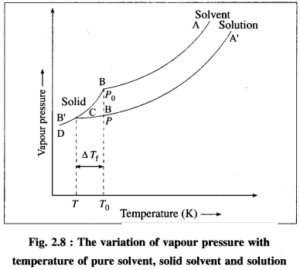
The freezing point of a liquid is the temperature at which the liquid and the solid have the same vapour pressure.

Addition of a nonvolatile solute to a liquid decreases the freezing point, i.e., the freezing point of the solution is less than that of the pure solvent. This is due to the lowering of the vapour pressure of the solvent by the addition of the nonvolatile solute.

When a liquid is cooled from the point A, its vapour pressure decreases and at the point B, it freezes (solidifies).

Image

In case of a solution, since the vapour pressure is lowered, the freezing point decreases. Hence, if the solution is cooled from the point A’, it freezes at lower temperature B’, than the pure liquid. This is also due to separation of solvent molecules due to solute molecules decreasing their intermolecular attraction.

If $T_0$ and $T$ are the freezing points of a pure solvent and the solution, then, the depression in the freezing point is given by,
$\Delta T_f=T_0-T$
This depression $\Delta T_f$ depends on the lowering of the vapour pressure $\left(P_0-P\right) . \Delta T_f \propto\left(P_0-P\right)$, where $P_0$ and $P$ are the vapour pressures of the pure liquid and the solution.

Need a full question paper?

Generate a complete, print-ready paper with questions like this in minutes — across 16+ boards, with answer keys.

Start Generating Free