MCQ
What causes spectral lines?
  • A
    The transition of electrons between two energy levels.
  • B
    The transition of electrons between two wavelength ranges.
  • Magnetic and electric field exiting in an atom.
  • D
    The transition of electrons from electric to magnetic field.
Answer

Correct option: C.
Magnetic and electric field exiting in an atom.

The observed spectral lines are caused by the transition of electrons between two energy levels in an atom.
The emission spectrum of the hydrogen atom is divided into many spectral series, with wavelengths that are given by Rydberg’s formula.

Need a full question paper?

Generate a complete, print-ready paper with questions like this in minutes — across 16+ boards, with answer keys.

Start Generating Free

Similar questions

The permanent magnetic moment of the atoms of a material is not zero. The material:
A circular coil of wire consisting of $100$ turns, each of radius $8.0\; cm$ carries a current of $0.40\, A$. What is the magnitude of the magnetic field $B$ at the centre of the coil?
A nucleus of atomic mass $A$ and atomic number $Z$ emits ${M_1}$ particles. The atomic mass and atomic number of the resulting nucleus are
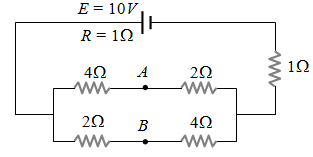
In the circuit shown below, the cell has an e.m.f. of 10 V and internal resistance of 1 ohm. The other resistances are shown in the figure. The potential difference $V_A-V_B$ is

A man runs towards mirror at a speed of 15 m/s. What is the speed of his image
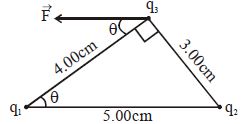
Three charges are placed as shown in figure. The magnitude of $q_1$ is $2.00\, \mu C$, but its sign and the value of the charge $q_2$ are not known. Charge $q_3$ is $+4.00\, \mu C$, and the net force on $q_3$ is entirely in the negative $x-$ direction. The magnitude of $q_2$ is
The number of photons of wavelength $540 nm$ emitted per second by an electric bulb of power $100W$ is (taking  $h =6 \times {10^{ - 34}}\,J{\rm{ - }}sec$)
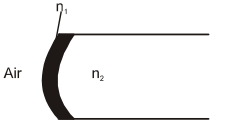
A transparent thin film of uniform thickness and refractive index $n_1=1.4$ is coated on the convex spherical surface of radius $R$ at one end of a long solid glass cylinder of refractive index $n_2=1.5$. as shown in the figure. Rays of light of light parallel to the axis of the cylinder traversing through the film from air to glass get focused at distance $f _1$ from the film, while rays of light traversing from glass to air get focused at distance $f _2$ from the film. Then

$Image$

$(A)$ $\left|f_1\right|=3 R$ $(B)$ $\left|f_1\right|=2.8 R$ $(C)$ $\left| f _2\right|=2 R$ $(D)$ $\left|f_2\right|=1.4 R$

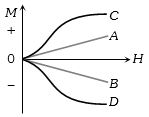
The most appropriate magnetization $M$ versus magnetising field $ H $ curve for a paramagnetic substance is
There is some liquid in a closed bottle. The amount of liquid is continuously decreasing. The vapour in the remaining part: