MCQ
What changes does not occur when $K_2Cr_2O_7$ react with $H_2O_2$ solution
  • A
    Orange colour of solution turns blue
  • $O.S$. of $Cr$ atom decreases
  • C
    $O.S.$ of $Cr$ atom remains constant
  • D
    None of these

Answer

Correct option: B.
$O.S$. of $Cr$ atom decreases
b

Need a full question paper?

Generate a complete, print-ready paper with questions like this in minutes — across 16+ boards, with answer keys.

Start Generating Free

Similar questions

Product $(A)$ will be
$A\,\xrightarrow{{A{g_2}O}}$ ppt

$A\,\xrightarrow{{H{g^{2 + }}\,/\,{H^ + }}}B\,\xrightarrow{{NaB{H_4}}}C\,\xrightarrow[{conc.\,\,HCl}]{{ZnC{l_2}}}$  Turbidity within $5$ minutes.

Consider the following reactions $‘A’$ is

Which of the following compound does not undergo base - catalyzed exchange in  $D_2O$ even though it has an $\alpha$ -hydrogen?
The third ionization energy is maximum for
Consider the following statement Acetophenone can be prepared by

$(1)$ Oxidation of $1-$ phenylethanol

$(2)$ Reaction of benzalthanol with methyl magnesium bromide

$(3)$ Friedel craft’s reaction of benzene with acetyl chloride

$(4)$ Distillation of calcium benzoate
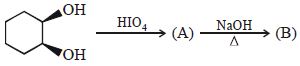
In a complexometric tritration of metal ion with ligand $M$ (Metalion) $+L$ (Ligand) $\to $ $C$ (Complex) end point is estimated spectrophotometrically (through light absorption) If $'M'$  and $'C'$  do not absorb light and only $'L'$  absorbs, then the titration plot between absorbed light $(A)$  versus volume of ligand $'L'$  $(V)$  would look like
Product "$B$" is :
Consider following two reaction,

$A \to {\text{Product ;}}\,\, - \frac{{d[A]}}{{dt}} = {k_1}{[A]^o}$

$B \to {\text{Product ;}}\,\, - \frac{{d[B]}}{{dt}} = {k_2}{[B]}$

Units of $k_1$ and $k_2$ are expressed in terms of molarity $(M)$ and time $(sec^{-1})$ as
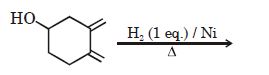
Major product of above reaction is 
$B{X_3} + N{H_3}\xrightarrow{{R.T}}B{X_3}.N{H_3} + Heat\,of\,adduct\,formation\,\left( {\Delta H} \right)$ The numerical value of $\Delta H$ is found to be maximum for