Question
What conclusion can you draw about displacement current and conduction current?

Answer

(1) Displacement current and conduction current are discontinuous separately but both currents are continuous together at closed path.
(2) Displacement current like conduction current is a source of magnetic field.
(3) Both currents are always equal to each other.
(4) Displacement current is always produced due to change in electric field between the plates of the capacitor.
(5) Current I is between the plates of the capacitor and conduction current is in the wire joining the plates and source of emf.

Need a full question paper?

Generate a complete, print-ready paper with questions like this in minutes — across 16+ boards, with answer keys.
Start Generating Free

Similar questions

Does a nucleus lose mass when it suffers gamma decay?
A particle goes in a circle of radius 2.0cm. A concave mirror of focal length 20cm is placed with its principal axis passing through the centre of the circle and perpendicular to its plane. The distance between the pole of the mirror and the centre of the circle is 30cm. Calculate the radius of the circle formed by the image.
Let $\overrightarrow{\text{A}}$ and $\overrightarrow{\text{B}}$ be the two vectors of magnitude 10 unit each. If they are inclined to the X-axis at angles 30° and 60° respectively, find the resultant.
A rod is inserted as the core in the current-carrying solenoid of the previous problem.
  1. What is the magnetic intensity H at the centre?
  2. If the magnetization I of the core is found to be 0.12Nm, find the susceptibility of the material of the rod.
  3. Is the material paramagnetic, diamagnetic or ferromagnetic?
An electric field of $20NC^{-1}$ exists along the x-axis in space. Calculate the potential difference $V_B - V_A$ where the points A and B are given by,
  1. $A = (0, 0); B = (4m, 2m)$
  2. $A = (4m, 2m); B = (6m, 5m)$
  3. $A = (0, 0); B = (6m, 5m)$
Do you find any relation between the answers of parts (a), (b) and (c)?
Calculate the height of the potential barrier for a head on collision of two deuterons. (Hint: The height of the potential barrier is given by the Coulomb repulsion between the two deuterons when they just touch each other. Assume that they can be taken as hard spheres of radius 2.0 fm.)
The first excited energy of a $He^+$ ion is the same as the ground state energy of hydrogen. Is it always true that one of the energies of any hydrogen-like ion will be the same as the ground state energy of a hydrogen atom?
Define the terms ‘stopping potential’ and ‘threshold frequency’ in relation to photoelectric effect. How does one determine these physical quantities using Einstein’s equation?
(I) Draw the energy band diagram for P-type semiconductor at (i) T=0K and (ii) room temperature.
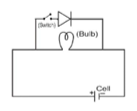
(II) In the given diagram considering an ideal diode, in which condition will the bulb glow
(a) when the switch is open
(b) when the switch is closed
Justify your answer.

Image
Visible light has wavelengths in the range of 400nm to 780nm. Calculate the range of energy of the photons of visible light.