Question
What did Rutherford’s alpha particle experiment prove?

Answer

  1. Nucleus
Explanation:
Rutherford’s alpha particle experiment proved the existence of the nucleus.

Need a full question paper?

Generate a complete, print-ready paper with questions like this in minutes — across 16+ boards, with answer keys.
Start Generating Free

Similar questions

Consider the following statements about sound passing through a gas.
  1. The pressure of the gas at a point oscillates in time.
  2. The position of a small layer of the gas oscillates in time.
  1. Both A and B are correct.
  2. A is correct but B is wrong.
  3. B is correct but A is wrong.
  4. Both A and B are wrong.
Which of the following is used to produce radio waves of constant amplitude(a) Oscillator (b) FET (c) Rectifier(d) Amplifier
       
Two bodies at different temperatures are mixed in a calorimeter. Which of the following quantities remains conserved?
  1. Sum of the temperatures of the two bodies.
  2. Total heat of the two bodies.
  3. Total internal energy of the two bodies.
  4. Internal energy of each body.
In hydrogen atom, when electron jumps from second to first orbit, then energy emitted is (a) – 13.6 eV(b) – 27.2 eV(c) – 6.8 eV(d) None of these
       
The acceleration of moon with respect to earth is $0⋅0027\ ms^{-2}$ and the acceleration of an apple falling on earth's surface is about $10\ ms^{-2}.$ Assume that the radius of the moon is one fourth of the earth's radius. If the moon is stopped for an instant and then released, it will fall towards the earth. The initial acceleration of the moon towards the earth will be:
A coil of self-inductance L is connected in series with a bulb B and an AC source. Brightness of the bulb decreases when.
A thin transparent sheet is placed in front of a Young's double slit. The fringe-width will:
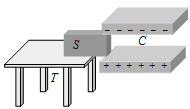
A frictionless dielectric plate $S$ is kept on a frictionless table $T$. A charged parallel plate capacitance $C\ ($of which the plates are frictionless$)$ is kept near it. The plate $S$ is between the plates. When the plate $S$ is left between the plates
Which of the following statements is not correct?
In a nuclear fission reaction(a) Two light nuclei combine to produce a heavier nucleus(b) A light nucleus bombarded by thermal neutrons breaks up(c) A heavy nucleus bombarded by thermal neutrons breaks up(d) A heavy nucleus breaks up by itself