Gujarat BoardEnglish MediumSTD 9ScienceTissues5 Marks
Question
What do you know about complex tissue Classify and explain its different types in plants with suitable diagrams.
✓
Answer
The complex tissue consists of more than one type of cells having a common origin. They are of two types:
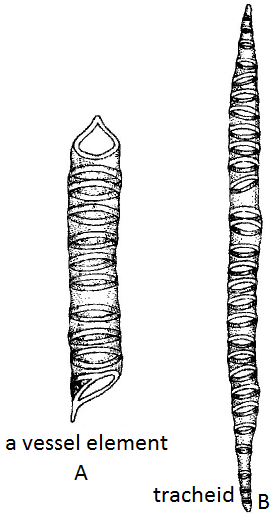
Xylem: Xylem is a vascular and mechanical tissue which conducts water. Xylem is composed of cells of four different types:
Tracheids.
Vessels or tracheae.
Xylem parenchyma.
Xylem Sclerenchyma.
Except xylem parenchyma, all other xylem elements are dead and bounded by thick lignified walls. Vessels are shorter and wider than tracheids. Vessels are very long tube-like structures formed by a row of cells placed end to end. Tracheids are elongated cells with tapering ends. They also conduct water.
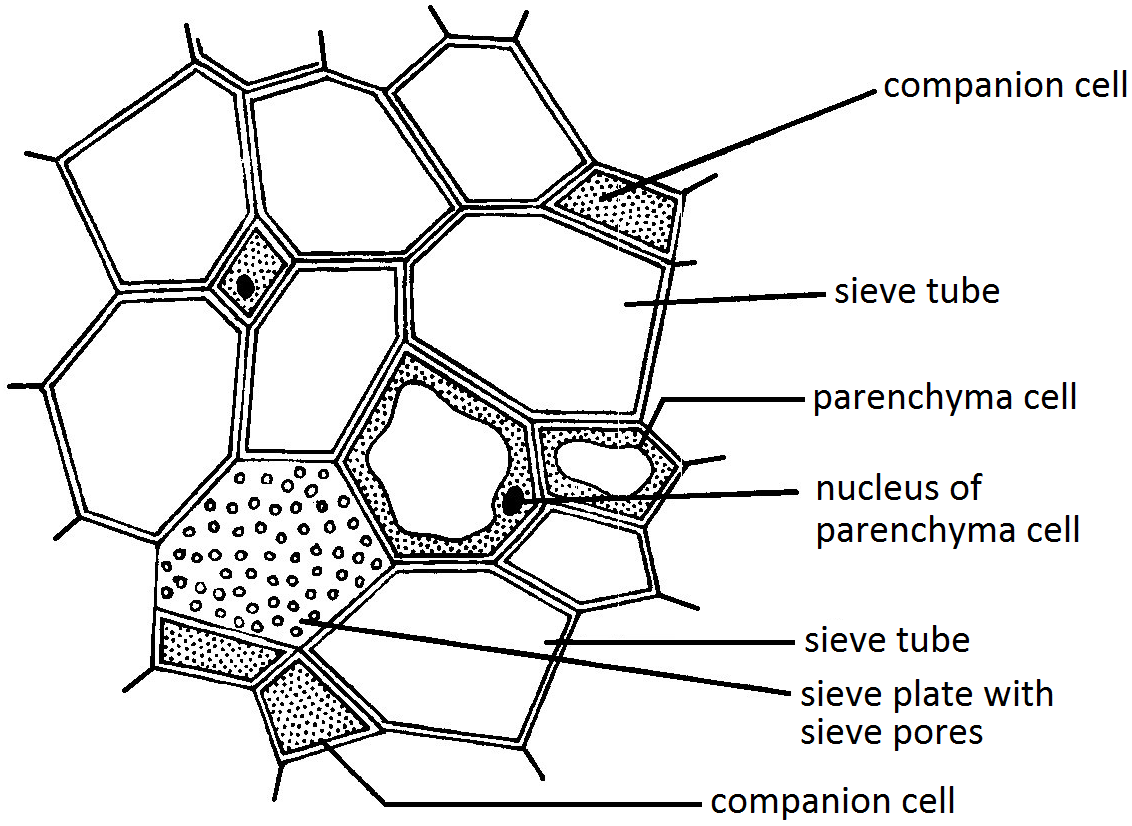
Phloem: Phloem is also a vascular tissue which transports food from the leaves to the various parts of the plant. It is composed of:
Sieve tubes: Sieve tubes are slender, tube-like structures composed of elongated thin-walled cells, placed end to end. Their end walls are perforated by numerous pores and are called sieve plates.
Companion Cells: It is a small thin-walled cell containing dense and very active cytoplasm and large elongated nucleus.
Phloem parenchyma: These are thin-walled, living cells of parenchyma of phloem. They have two functions, storage and slow lateral conduction of food.
Phloem Fibres: These are thick-walled, elongated spindled shaped dead cells which posses narrow lumen. They provide mechanical strength to the tissue.
Need a full question paper?
Generate a complete, print-ready paper with questions like this in minutes — across 16+ boards, with answer keys.