Question
What do you mean by a precipitation reaction? Explain giving an example.

Answer

Any reaction in which an insoluble solid (called precipitate) is formed that separates from the solution is called a precipitation reaction.
Example: The reaction between barium chloride and sodium sulphate solution to form a white barium sulphate precipitate (alongwith sodium chloride solution) is an example of a precipitation reaction.
$\text{BaCl}_2(\text{aq})\ \ \ +\ \ \ \text{NaSO}_4(\text{aq})\xrightarrow{\ \ \ \ \ \ \ \ \ \ \ \ }\ \text{BaSO}_4(\text{s})\ \ \ \ +\ \ \ 2\text{NaCl(aq)}\\ ^\text{Barium Chloride}\ \ \ \ \ \ \ ^\text{Sodium sulphate}\ \ \ \ \ \ \ \ \ \ \ \ \ ^\text{Barium sulphate}\ \ \ \ \ \ \ \ ^\text{Sodium Chloride}\\ \ \ \ \ \ \ \ \ \ \ \ \ \ \ \ \ \ \ \ \ \ \ \ \ \ \ \ \ \ \ \ \ \ \ \ \ \ \ \ \ \ \ \ \ \ \ \ \ \ \ \ \ \ \ \ \ \ \ \ \ \ \ \ ^\text{(White ppt.)}$

Need a full question paper?

Generate a complete, print-ready paper with questions like this in minutes — across 16+ boards, with answer keys.

Start Generating Free

Similar questions

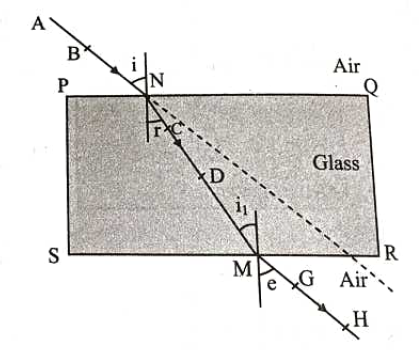
Observe the figure and name the ray AB , ray CD, ray GH:
Image
State the four characteristics of homologous series.
The observations made by Swarali while doing the experiment are given below. Based on these write answers to the questions:
Swarali found that the light ray travelling from the denser medium to a rarer medium goes away from the normal. If the angle of incidence (i) is raised by Swarali, the angle of refraction (r) went on increasing. However, after certain value of the angle of incidence, the light ray is seen to return back into the denser medium. (March 2019)
(i) What is the specific value of ∠i called?
(ii) What is the process of reflection of incident ray into a denser medium called?
(iii) Draw the diagrams of three observations made by Swarali.
State the three common features of all the respiratory organs like skin, gills and lungs.
What is, highest, and lowest, resistance which can be obtained by combining Com resistors having the following resistances?
$4 Ω, 8 Ω, 12 Ω, 24 Ω$
State the various steps involved in the process of photosynthesis.
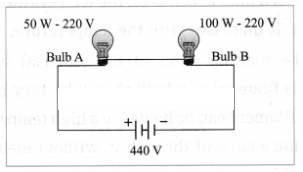
Observe the following figure. Which bulb will fuse? (Practice Activity Sheet – 4)

Image

A $2.0\ cm$ tall object is placed $40\ cm$ from a diverging lens of focal length $15\ cm$. Find the position and size of the image.
Identify the process given below and accordingly draw neat labelled diagram:
A molten mixture of alumina (melting point $>2000^{\circ} C$ ) is done in a steel tank. The tank has a graphite lining on the inner side. The lining does the work of cathode. A set of graphite rods dipped in the molten electrolyte works as anode. Cryolite $\left( Na _3 AlF _6\right)$ and fluorspar $\left( CaF _2\right)$ are added in the mixture to lower its melting point upto $1000^{\circ} C$.
If the power of a lens is 4 dioptres, find its focal length.