Question
What do you mean by gravitational constant? State its SI units.

Answer

From Newton’s law of gravitation,
$F=G \frac{m_1 m_2}{r^2}$
where, G = constant called universal gravitational constant Its value is $667 X 10^{-11} N m^2/kg^2$.
$G=\frac{F_r^2}{ m _1 m _2}$
If $m_1=m_2=1 kg , r=1 m$ then $F=G$.
  1. Hence, the universal gravitational constant is the force of gravitation between two particles of unit mass separated by unit distance.
  2. Unit: $N m^2/kg^2$​​​​​​​ in SI system.

Need a full question paper?

Generate a complete, print-ready paper with questions like this in minutes — across 16+ boards, with answer keys.
Start Generating Free

Similar questions

What is the gravitational potential due to the Earth at a point which is at a height of $2R_E$​​​​​​​ above the surface of the Earth, Mass of the Earth is $6 \times 10^{24}​​​​​​​ kg$, radius of the Earth $= 6400\ km$ and G $= 6.67 \times 10^{-11} Nm^2 kg^{-2}.$
A force $\overrightarrow{ F }=4 \hat{ i }+6 \hat{ j }+3 \hat{ k }$ acting on a particle produces a displacement of $\overrightarrow{ S }=$ $\overrightarrow{ s }=2 \hat{ i }+3 \hat{ j }+ 5 \hat{ k }$ where $F$ is expressed in newton and $s$ in metre. Find the work done by the force.
What will be the change in potential energy of a body of mass $m$ when it is raised from height $R_E$ above the Earth’s surface to $5/2 R_E$ above the Earth’s surface? $R_E$ and $M_E$ are the radius and mass of the Earth respectively.
Calculate the $B.E.$ of a satellite of mass $2000 \ kg$ moving in an orbit very close to the surface of the Earth. $(G = 6.67 \times 10^{-11} N m^2/kg^2)$
For an orbiting satellite very close to surface of the Earth, show that $T=2 \pi \sqrt{\frac{ R }{ g }}$.
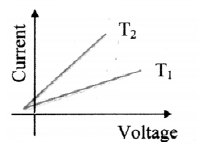
From the graph given below, which of the two temperatures is higher for a metallic wire? Justify your answer.
Image
The speed of light is $3 \times 10^8 m / s$. Calculate the frequency of red light of wavelength of $6.5 \times 10^{-7} m$.
While rotating an object or while opening a door or a water tap we apply a force or forces. Under which conditions is this process easy for us? Why? Define the vector quantity concerned. How does it differ for a single force and for two opposite forces with different lines of action?
Discuss the following as special cases of elastic collisions and obtain their exact or approximate final velocities in terms
of their initial velocities.
(i) Colliding bodies are identical.
(ii) A very heavy object collides on a lighter object, initially at rest.
(iii) A very light object collides on a comparatively much massive object, initially at rest.
What is random error (accidental)?