Question
What do you mean by mass energy equivalence? Give example.

Answer

Mass-energy equivalence was propounded by Albert Einstein. It states that energy and mass are interconvertible. Example: An $\mathrm{e}^{-}$(electron) collides with an $\mathrm{e}^{+}$(positron) and the two annihilate giving two photons. The total mass of $\mathrm{e}^{-}$and $\mathrm{e}^{+}$is converted into energy.

Need a full question paper?

Generate a complete, print-ready paper with questions like this in minutes — across 16+ boards, with answer keys.
Start Generating Free

Similar questions

Find the length of a second pendulum on the moon where the value of gravitational acceleration is equal to the gravitational acceleration of the earth is more $\frac{1}{6}$ times. (On earth $g=9.8 m / s ^2$ )
Can a room be cooled by leaving the door of an electric refrigerator open?
In an electrolyte, the positive ions move from left to right and the negative ions from right to left. Is there a net current? If yes, in what direction?
Write Maxwell's law of equipartition of energy.
Calculate the power developed by a person, while eating 100g of ice per minute. Latent heat of ice $=80 \mathrm{cal} / \mathrm{g}^{-7}$.
An observer at a sea-coast observes waves reaching the coast. What type of waves does he observe? Why?
8 gm of oxygen, 14 gm of nitrogen and 22 gm of carbon dioxide are mixed in a vessel of 10 liters volume and $27^{\circ} C$. Find the pressure exerted by the mixture.
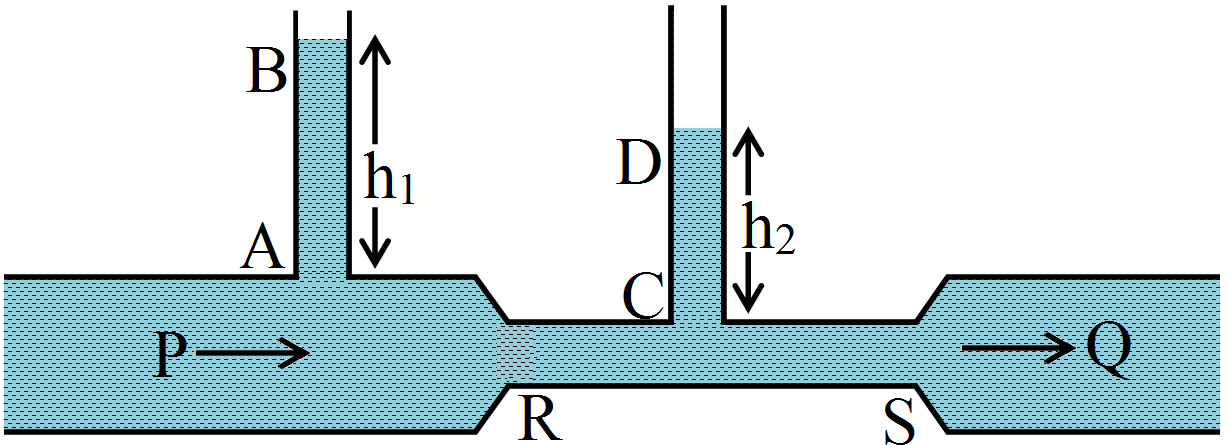
As shown in figure, water flows from P to Q. Explain why height h, of column AB of water is greater than height h, of column CD of water.
A steel wire and a copper wire of equal length and equal cross$-$sectional area are joined end to end and the combination is subjected to a tension. Find the ratio of.
  1. The stresses developed in the two wires.
  2. The strains developed. $Y$ of steel $= 2 \times 10^{11}N/m^2$. Y of copper = $1.3 \times 10^{11}N/m^2$.
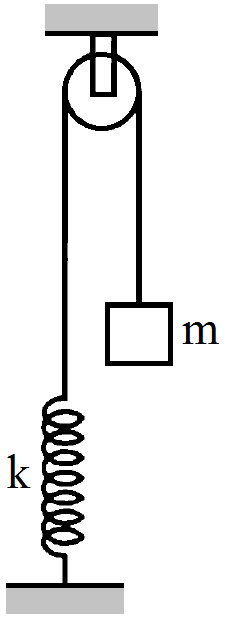
Consider the situation shown in figure. Initially the spring is unstretched when the system is released from rest. Assuming no friction in the pulley, find the maximum elongation of the spring.