Question
What do you mean by the elastic limit?

Answer

When the deforming force is increased, a limit is reached beyond which the solid does not come back to its original shape or size but remains deformed on removal of applied force. This limit is called the elastic limit.

Need a full question paper?

Generate a complete, print-ready paper with questions like this in minutes — across 16+ boards, with answer keys.

Start Generating Free

Similar questions

The audible frequency range of a human ear is 20Hz-20kHz. Convert this into the corresponding wavelength range. Take the speed of sound in air at ordinary temperature to be 340m/s.
Explain, what do you understand by the efficiency of a heat engine?
A lady walking towards east on a road with velocity of 10m/ s encounters rain falling vertically with a velocity of 30m/ s. At what angle she should hold her umbrella to protect herself from the rain?
Write an expression for the moment of inertia of a circular disc of mass $M$ and radius $R.$
  1. About an axis passing through its centre, and perpendicular to its plane.
  2. About its diameter.
  3. About a tangent to its own plane.
  4. About a tangent perpendicular to the plane of the disc.
Read statement below carefully and state with reasons and examples, if it is true or false; A particle in one-dimensional motion. With constant speed must have zero acceleration.
Magnitude of force F experienced by a certain object moving with speed v is given by $F = Kv^2$ where K is a constant. Find the dimensions of K.
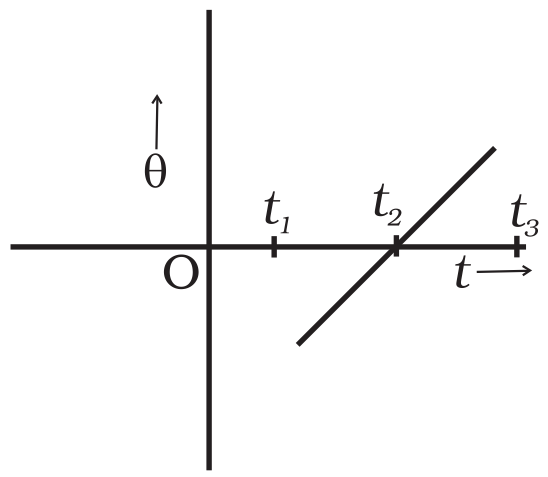
The variation of angular position of a point on a rotating rigid body, with time t is shown in is the body rotating clock-wise or anti-clockwise?
What is meant by 'point object' in physics?
Show that the internal energy of the air (treated as an ideal gas) contained in a room remains constant as the temperature changes between day and night. Assume that the atmospheric pressure around remains constant and the air in the room maintains this pressure by communicating with the surrounding through the windows, doors, etc.
Calculate the difference between two principal specific heats of 1g of helium gas at N.T.P. Molecular weight of helium = 4u and $J = 4.186Jcal^{-1}$ and $R = 8.31 J ~mole^{-1} K^{-1}$.