Question
What do you understand by controlled and uncontrolled chain reactions?

Answer

Controlled chain reaction : If the chain reaction of fission can be controlled in such a way that it neither increases nor decreases, that is, such a level of reaction is maintained such that the energy released per second always remains less than the limit of explosion. This is called controlled chain reaction. This type of reaction is used in the production of electrical energy. Controlled chain reaction is the fundamental basis of 'nuclear reactor'.
Uncontrolled chain reaction : In this reaction, on average, more than one neutron takes part in the process of fission out of the neutrons obtained from each fission. Here $K >1$. Due to this, the rate of fission of nuclei increases rapidly and within a few moments tremendous energy is released and causes a massive explosion. This reaction takes place in the atomic bomb.

Need a full question paper?

Generate a complete, print-ready paper with questions like this in minutes — across 16+ boards, with answer keys.

Start Generating Free

Similar questions

Consider a 10cm long piece of a wire which carries a current of 10A. Find the magnitude of the magnetic field due to the piece at a point which makes an equilateral triangle with the ends of the piece.
The radius of innertmost orbit of hydrogen atom is $5.3 \times 10^{-11} m$. What is the radius of second excited state?
A free atom of iron emits $\text{K}_\alpha$ X-rays of energy 6.4keV. Calculate the recoil kinetic energy of the atom. Mass of an iron atom $= 9.3 \times 10^{-26}kg.$
A circular loop of radius 20cm carries a current of 10A. An electron crosses the plane of the loop with a speed of $2.0 \times 10^6m/s$. The direction of motion makes an angle of 30° with the axis of the circle and passes through its centre. Find the magnitude of the magnetic force on the electron at the instant it crosses the plane.
A cylinder rotating at an angular speed of 50rev/s is brought in contact with an identical stationary cylinder. Because of the kinetic friction, torques act on the two cylinders, accelerating the stationary one and decelerating the moving one. If the common magnitude of the acceleration and deceleration be one revolution per second square, how long will it take before the two cylinders have equal angular speed?
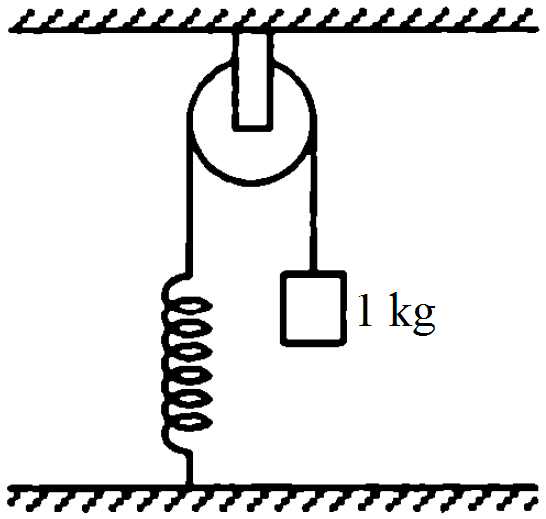
The pulley shown in figure has a radius of 20cm and moment of inertia $0.2kg-m^2.$ The string going over it is attached at one end to a vertical spring of spring constant 50N/m fixed from below, and supports a 1kg mass at the other end. The system is released from rest with the spring at its natural length. Find the speed of the block when it has descended through 10cm. Take $g = 10m/s^2.$​​​​​​​
Is there any meaning of "Weight of the earth"?
  1. Derive an expression for drift velocity of free electrons.
  2. How does drift velocity of electrons in a metallic conductor vary with increase in temperature? Explain.
Why alternating current of 220 V is more dangerous than direct current of 220 V ?
A tunnel is dug along a chord of the earth at a perpendicular distance $\frac{\text{R}}{2}$ from the earth's centre. The wall of the tunnel may be assumed to be frictionless. Find the force exerted by the wall on a particle of mass m when it is at a distance x from the centre of the tunnel.