Question
What do you understand by specific charge?

Answer

If mass of a particle is $m$ and charge on it is $q$. then the ratio $\frac{q}{m}$ is known as specific charge of the particle.

Need a full question paper?

Generate a complete, print-ready paper with questions like this in minutes — across 16+ boards, with answer keys.
Start Generating Free

Similar questions

Sometimes it is said that "heat is developed" in a resistance when there is an electric current in it. Recall that heat is defined as the energy being transferred due to temperature difference. Is the statement in quotes technically correct?
In the case of forward bias, the P end of a $P - N$ junction diode is connected to which terminal of the battery?
In Rutherford's scattering model, it is shown that : (i) mostly alpha particle passes direct linearly without scattering, (ii) while some scattered by making large angle and some of these after scattering returned back to their path. What is the information obtained from these about atomic structure?
Draw three equipotential surfaces corresponding to the field whose magnitude increases uniformly, but remains constant along the z-direction. How are these surfaces different from those that lie along the z- direction of a constant electric field?
In an ac circuit, instantaneous current and voltage are $I = I _0 \sin 300 t A$ and $V =200 \sin 300 t$ respectively. What is average power dissipated in the circuit?
Can the peak voltage across the inductor be greater than the peak voltage of the source in an LCR circuit?
A photosensitive surface emits photoelectrons when red light falls on it. Will the surface emit photoelectrons when blue light is incident on it? Give reason.
When a dielectric slab is gradually inserted between the plates of an isolated parallel-plate capacitor, the energy of the system decreases. What can you conclude about the force on the slab exerted by the electric field?
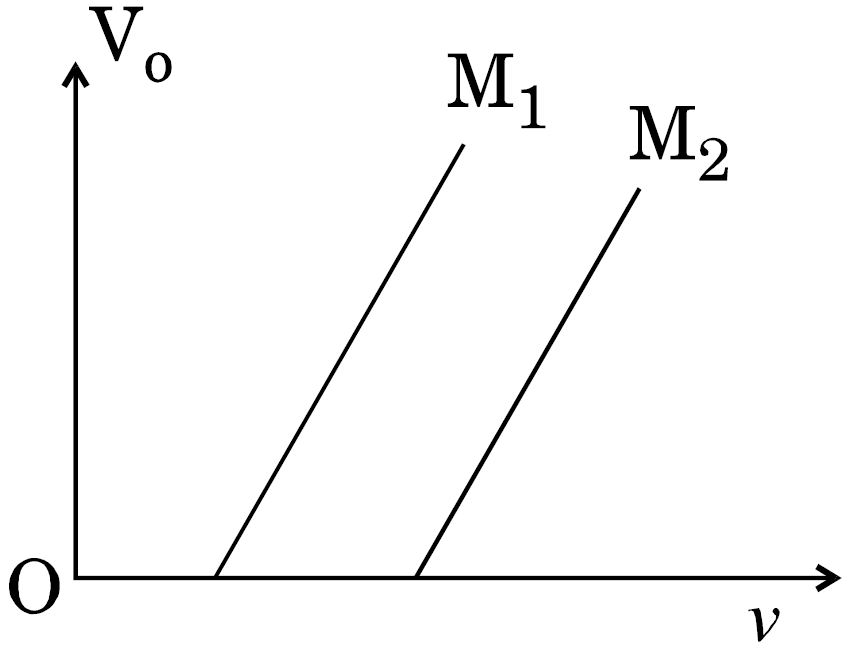
The variation of the stopping potential (V0) with the frequency (v) of the light incident on two different photosensitive surfaces M1 and M2 is shown in the figure. Identify the surface which has greater value of the work function.

A rubber balloon is given a charge Q distributed uniformly over its surface. Is the field inside the balloon zero everywhere if the balloon does not have a spherical surface?