Question
What do you understand by the terms “balanced forces” and “unbalanced forces”? Explain with examples.

Answer

  • Balanced forces: If the resultant of all the forces acting on a body is zero, the forces are called balanced forces. These forces do not change the state of rest or of uniform motion of a body but can change the shape of the body.
For example: when a balloon is pressed between hands, then balanced forces (equal and opposite forces) act on the balloon due to which the shape of the balloon changes.
  • Unbalanced forces: If the resultant of all the forces acting on a body is not zero, the forces are called unbalanced forces. These forces change the state of rest or of uniform motion of a body.
For example: if we push a toy car lying on the ground, it starts moving due to the unbalanced force exerted by our hands.

Need a full question paper?

Generate a complete, print-ready paper with questions like this in minutes — across 16+ boards, with answer keys.
Start Generating Free

Similar questions

What do you understand by the terms “balanced forces” and “unbalanced forces”? Explain with examples.
The distance between Delhi and Agra is 200km. A train travels the first 100km at a speed of 50km/h. How fast must the train travel the next 100km, so as to average 70km/h for the whole journey?
What are longitudinal waves and transverse waves? Explain with the help of labelled diagrams.
Explain the transformation of energy in the following cases:
  1. A ball thrown upwards.
  2. A stone dropped from the roof of a building.
Which contains more molecules, $10\ g$ of sulphur dioxide $\left( SO _2\right)$ or $10\ g$ of oxygen $\left( O _2\right)$ ? (Atomic masses: $S =32 u ; O =16 u$ )
Define soil erosion. Give its causes, effects and preventive measures.
A car travels $100\ km$ at a speed of $60\ km/h$ and returns with a speed of $40\ km/h.$ Calculate the average speed for the whole journey.
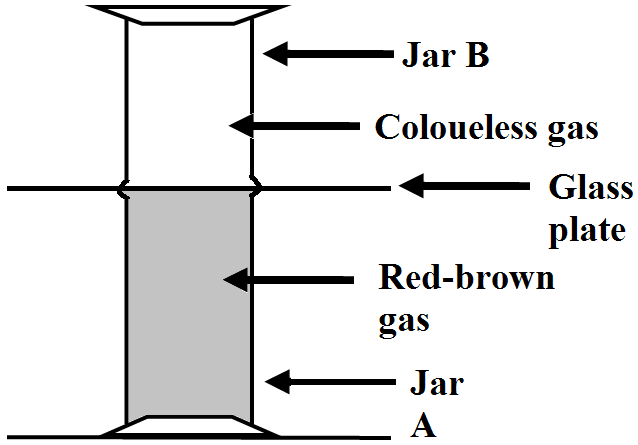
Look at the diagram on the right side. Jar $A$ contains are d-brown gas whereas Jar $B$ contains a colourless gas. The two gas jars are separated by a glass plate placed between them:
  1. What will happen when the glass plate between the two jars is pulled away?
  2. What name is given to the phenomenon which takes place?
  3. Name the brown gas which could be in jar $A$.
  4. Which is the colorless gas most likely to be present in jar $B$?
  5. Name one coloured solid and one colourless liquid which can show the same phenomenon.
Explain the terms 'compression' and 'rarefactions' of a wave. What type of waves consist of compressions and rarefactions?
Define diarrhoea. Give an account of occurrence, symptoms, prevention and control of this ailment.