Question
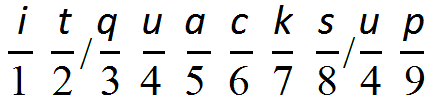
What does a duck do when it flies upside down? The answer to this riddle is hidden in the equation given below: If $i + 69 = 70$, then $i = ?$ If $8u = 6u + 8$, then $u = ?$ If $4a = –5a + 45$, then $a = ?$ if $4q + 5 = 17$, then $q = ?$ If $- 5t - 60 = -70$, then $t = ?$ If $\frac{1}{4}\text{s} + 98 = 100$, then $s = ?$ If $\frac{5}{3}\text{p} + 9 = 24$, then = ______? If $3c = c + 12$, then $c =$ ______? If $3(k + 1) = 24$, then k = ______? For riddle answer: substitute the number for the letter it equals.

Answer

We have, $i + 69 = 70$ [transposing $69$ to $RHS]$
$\Rightarrow i = 1$ and $8u = 6u + 8$
$\Rightarrow8\text{u}=6\text{u}+8$ [transposing $6u$ to $RHS]$
$\Rightarrow2\text{u}=8$
$\Rightarrow\frac{2\text{u}}{2}=\frac{8}{2}$ [dividing both sides by $2]$
$\Rightarrow\text{u}=4$
We have, $4a = -5a + 45$
$\Rightarrow4\text{a}+5\text{a}=45$ [transposing $(-5a)$ to $LHS]$
$\Rightarrow9\text{a}=45$
$\Rightarrow\frac{9\text{a}}{9}=\frac{45}{9}$ [dividing both sides by $9]$
 $\Rightarrow\text{a}=5$ and $4q + 5 = 17$
 $\Rightarrow4\text{q}=17-5$ [transposing $5$ to $RHS] $
$\Rightarrow4\text{q}=12$
$\Rightarrow\frac{4\text{q}}{4}=\frac{12}{4}$ [dividing both sides by $4]$
$\Rightarrow\text{q}=3$
We have,$ -5t - 60 = -70$
$\Rightarrow-5\text{t}=-70+60$ [transposing $(-60)$ to $RHS$]
$\Rightarrow-5\text{t}=-10$
$\Rightarrow\frac{-5\text{t}}{-5\text{}}=\frac{-10}{-5}$ [dividing both sides by $(-5)]$
$\Rightarrow\text{t}=2$ and $\frac{1}{4}\text{s}+98=100$
$\Rightarrow\frac{1}{4}\text{s}=100-98$ [transposing $98$ to $RHS]$
$\Rightarrow\frac{1}{4}\text{x}=2$
$\Rightarrow\frac{4}{4}\text{s}=4\times2$ [multiplying both sides by $4]$
$\Rightarrow\text{s}=8$
We have, $\frac{5}{3}\text{p}+9=24$
$\Rightarrow\frac{5}{3}\text{p}=24-9$ [transposing $9$ to $RHS]$
$\Rightarrow\frac{5}{3}\text{p}=15$
$\Rightarrow\frac{3}{5}\times\frac{5}{3}\text{p}=\frac{3}{5}\times15$
$\big[$ multiplying both sides by $\frac{3}{5}\big]$
$\Rightarrow\text{p}=9$
We have, $3c - c = 12$
$\Rightarrow3\text{c}=\text{c}+12$ [transposing c to $LHS]$
 $\Rightarrow2\text{c}=12$
$\Rightarrow\frac{2\text{c}}{2}=\frac{12}{2}$ [dividing both sides by $2]$
We have, $3(k + 1) = 24$
$\Rightarrow\frac{3(\text{k}+1)=24}{3}=\frac{24}{3}$ [dividing both sides by $3]$
$\Rightarrow\text{k}+1=8$
$\Rightarrow\text{k}=8-1$ [transposing $1$ to $RHS]$
​​​​​​​ $\Rightarrow\text{k}=7$ By substituting the number for the letter it equals, we get
​​​​​​​

Need a full question paper?

Generate a complete, print-ready paper with questions like this in minutes — across 16+ boards, with answer keys.

Start Generating Free

Similar questions

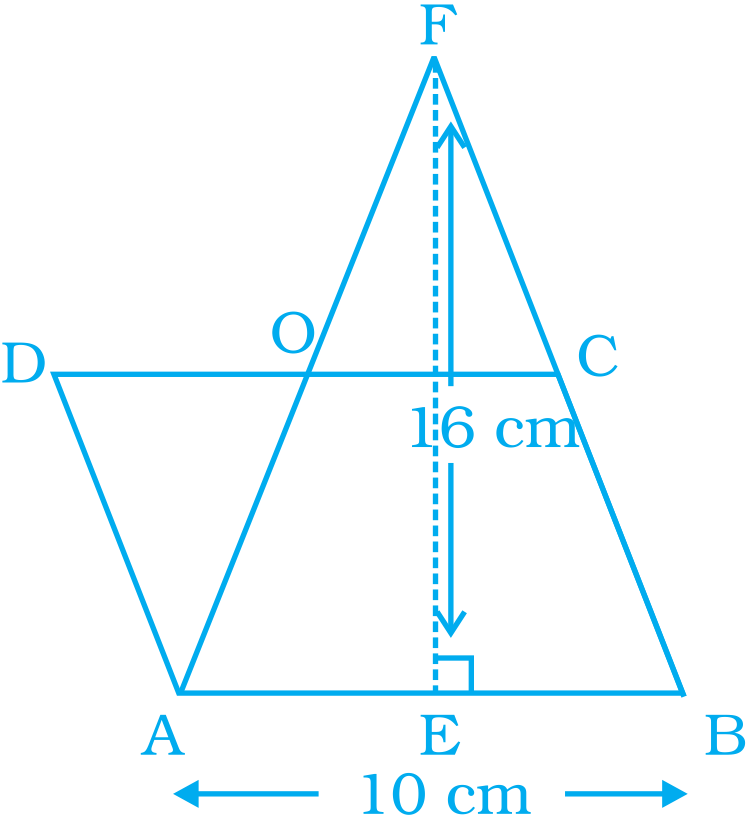
In Fig. area of $\angle \text{AFB}$ is equal to the area of parallelogram $ABCD$. If altitude $EF$ is $16\ cm$ long, find the altitude of the parallelogram to the base $AB$ of length $10\ cm.$
What is the area of $\angle \text{DAO}$, where $O$ is the mid point of $DC?$
Find the time when: A sum of money put at $11\%$ per annum amounts to $Rs. 4491$ in $2$ years $3$ months, what will it amount to in $3$ years at the same rate?
The following data shows India's total population (in millions) from $1961$ to $2011.$
Year
$1961$
$1971$
$1981$
$1991$
$2001$
$2011$
Population (in millions)
$360$
$420$
$540$
$680$
$1020$
$1200$
The table given below shows the population of four towns over two years:
Towns
$A$
$B$
$C$
$D$
$2016$
$640000$
$830000$
$460000$
$290000$
$2017$
$750000$
$920000$
$630000$
$320000$
$i.$ Draw a double bar graph using approprtate scale to depict the information given above.
$ii.$ In which town was the population growth maximum?
$iii.$ In which town was the population growth least?
Earth Science: The table lists the world’s $10$ largest deserts.
Largest Deserts in the World  
Desert Area $(km^2)$
Sahara $($Africa$)$ $8,800,000$
Gobi $($Asia$)$ $1,300,000$
Australian Desert $($Australia$)$ $1,250,000$
Arabian Desert $($Asia$)$ $850,000$
Kalahari Desert $($Africa$)$ $580,000$
Chihuahuan Desert $($North America$)$ $370,000$
Takla Makan Desert $($Asia$)$ $320,000$
Kara Kum $($Asia$)$ $310,000$
Namib Desert $($Africa$)$ $310,000$
Thar Desert $($Asia$)$ $260,000$
$a.$ What are the mean, median and mode of the areas listed?
$b.$ How many times the size of the Gobi Desert is the Namib Desert?
$c.$ What percentage of the deserts listed are in Asia?
$d.$ What percentage of the total area of the deserts listed is in Asia?
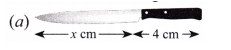
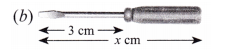
Look at the following and answer the questions :
Image
What is the length of the knife?

Image
What is length of the handle of the screwdriver?

Image
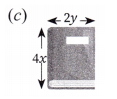
What is perimeter of the notebook?

Image
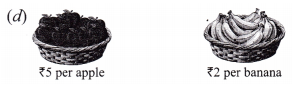
If there are x apples and y bananas in the baskets. What is the total cost of the fruits altogether?
Find the products: Multiply $-\frac{8}{21}\text{x}^2\text{y}^3\text{ by }-\frac{7}{16}\text{xy}^2$ and varify you result for $x = 3$ and $y = 2.$
Through a rectangular field of sides $90 m \times 60 m$, two roads are constructed which are parallel to the sides and cut each other at right angles through the centre of the field. If the width of the roads is 3 m , find the total area covered by the two roads.
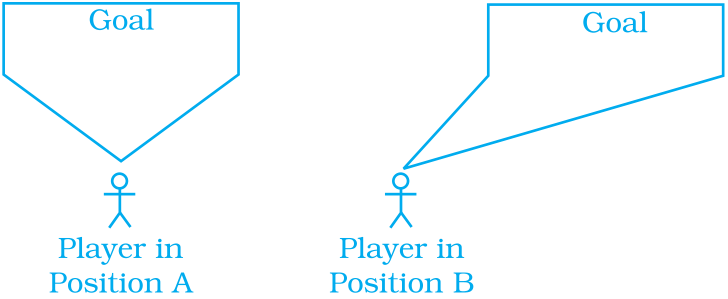
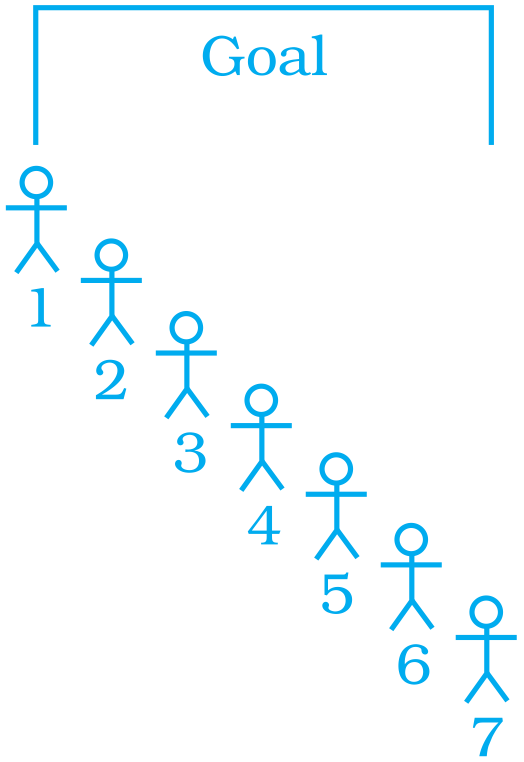
The drawings below $Fig.$ show angles formed by the goalposts at different positions of a football player. The greater the angle, the better chance the player has of scoring a goal. For example, the player has a better chance of scoring a goal from Position $A$ than from Position $B.$
$i.$


$ii.$


$iii.$

In Parts $(a)$ and $(b)$ given below it may help to trace the diagrams and draw and measure angles.
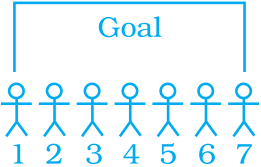
$a.$ Seven football players are practicing their kicks. They are lined up in a straight line in front of the goalpost $[Fig. (ii)].$ Which player has the best $($thegreatest$)$ kicking angle?
$b.$ Now the players are lined up as shown in $Fig. (iii)$. Which player has the best kicking angle?
$c.$ Estimate atleast two situations such that the angles formed by different positions of two players are complement to each other.
If the mean of the following data is $15$, find $p$.
x:
$5$
$10$
$15$
$20$
$25$
f:
$6$
$p$
$6$
$10$
$5$