Question
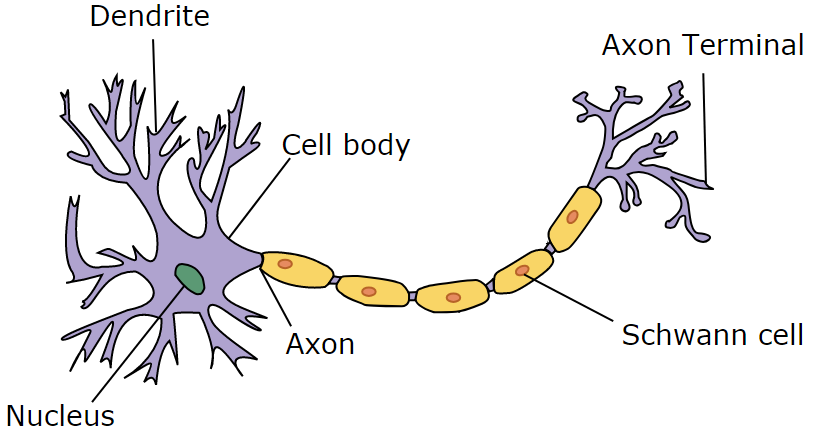
What does a neuron look like?
Answer


A neuron consists of a cell body witha nucleus and cytoplasm. It has two important extensions known as the axon and dendrites. An axon is a long thread-like extension of nerve cells that transmits impulses away from the cell body. Dendrites, on the other hand, are thread-like extensions of cell body that receive nerve impulses. Thus, the axon transmits impulses away from the cell body, whereas the dendrite receives nerve impulses. This coordinated function helps in transmitting impulses very quickly.

Need a full question paper?

Generate a complete, print-ready paper with questions like this in minutes — across 16+ boards, with answer keys.

Start Generating Free

Similar questions

Raunak took $5$ moles of carbon atoms in a container and Krish also took 5 moles of sodium atoms in another container of same weight.
$a.$ Whose container is heavier?
$b.$ Whose container has more number of atoms?
How will you separate common salt, sand and iron filings from their mixture?
Explain the terms 'compression' and 'rarefactions' of a wave. What type of waves consist of compressions and rarefactions?
What are longitudinal waves and transverse waves? Explain with the help of labelled diagrams.
Draw a well-labelled diagram of an eukaryotic nucleus. How is it different from nucleoid?
Write a note on cattle feed.
Define crop? Name the various types of crops. What are Kharif and Rabi crops?
Fill in the missing data in the following table.
Species Property $H_2O$ $CO_2$ Na atom $MgCl_2$
No. of moles $2$ $0.5$
No. of particles $3.011 \times 10^{23}$
Mass $36g$ $115g$
Describe structure and functions of plasma membrane.
There are three substances X, Y and Z. The substance X does not have a fixed melting point or boiling point and it still shows the individual properties of its constituents. The substance Y is a pure substance which occurs in nature as such. The substance Y has a fixed melting point and boiling point but it cannot be broken down into simpler substances by any chemical means. The substance Z is also a pure substance whose properties are entirely different from those of its constituents. The substance Z can, however, be divided by electrolysis into two substances which belong to the same class of substances as Y.
  1. What type of substance could X be? Name one substance like X.
  2. What type of substance could Y be? Name one substance like Y.
  3. What type of substance could Z be? Name one substance like Z.
  4. Whish process involves absorption or release of an appreciable amount of energy: formation of substance X or formation of substance Z?
  5. Name the three groups into which all the substances like Y are divided on the basis of their properties.