Question
What does a soda-acid type fire extinguisher contain? How does it work?
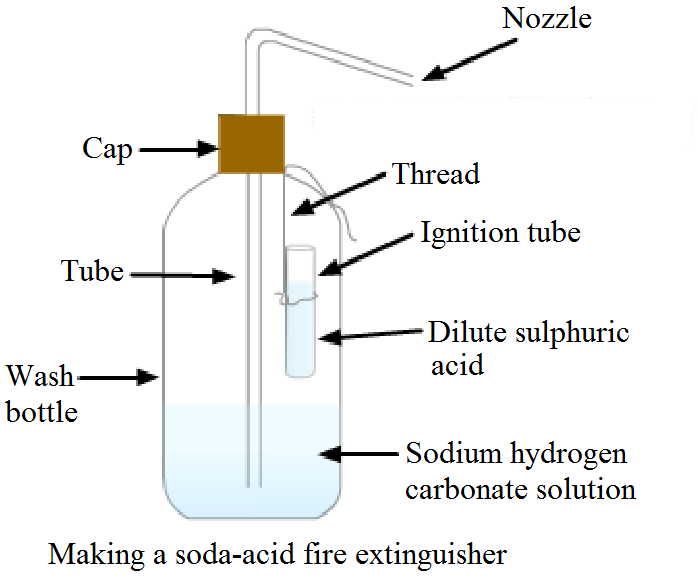
Explain the working of a soda- acid fire extinguisher with the help of a labelled diagram.
Answer

Working: A soda-acid type fire extinguisher contains a solution of sodium hydrogencarbonate and sulphuric acid in separate containers in separate containers inside them. When the knob of the fire extinguisher is pressed, then sulphuric acid mixes with sodium hydrogencarbonate solution to produce carbon dioxide gas which forms a blanket around the burning substance and cuts off the supply of air to burning substance; this stops the process of burning and fire gets extinguished.

Need a full question paper?

Generate a complete, print-ready paper with questions like this in minutes — across 16+ boards, with answer keys.

Start Generating Free

Similar questions

State and explain the reaction, if any, of the following metals with a solution of copper sulphate:
  1. Gold.
  2. Copper.
  3. Zinc.
  4. Mercury.
Explain some harmful effects of agricultural practices on the environment.
Analyse the following observation table showing variation of image distance (v) with object distance (u) in case of a convex lens and answer the questions that follow, without doing any calculations:
S. No.
Object distance u (cm)
Image distance v (cm)
1
-90
+18
2
-60
+20
3
-30
+30
4
-20
+60
5
-18
+90
6
-10
+100
  1. What is the focal length of the convex lens? Give reason in support of your answer.
  2. Write the serial number of that observation which is not correct. How did you arrive at this conclusion?
  3. Take an appropriate scale to draw ray diagram for the observation at S. No. 4 and find the approximate value of magnification.
Atoms of eight elements A, B, C, D, E, F, G and H have the same number of electron shells but different number of electrons in their outermost shells. It was found that elements A and G combine to form an ionic compound. This ionic compound is added in a small amount to almost all vegetables and dishes during cooking. Oxides of elements A and B are basic in nature while those of elements E and F are acidic. The oxide of element D is, however, almost neutral. Based on the above information, answer the following questions:
  1. To which group or period of the periodic table do these elements belong?
  2. What would be the nature of compound formed by a combination of elements B and F?
  3. Which two of these elements could definitely be metals?
  4. Which one of the eight elements is most likely to be found in gaseous state at room temperature?
  5. If the number of electrons in the outermost shell of elements C and G be 3 and 7 respectively, write the formula of the compound formed by the combination of C and G.
  1. A person cannot read newspaper placed nearer than 50 cm from his eyes. Name the defect of vision he is suffering from. Draw a ray diagram to illustrate this defect. List its two possible causes. Draw a ray diagram to show how this defect may be corrected using a lens of appropriate focal length.
  2. We see advertisements for eye donation on television or in newspapers. Write the importance of such advertisements.
What are the different methods of contraception?
When a person puts food in his mouth, then teeth cut it into small pieces, chew and grind it. The glands A in the mouth secrete a substance B which is mixed with the food by tongue. The substance B contains an enzyme C which starts the digestion of food in the mouth. The slightly digested food from the mouth goes down a tube D. The special type of movements E in the walls of tube D push the food into stomach for further digestion. The stomach wall secretes gastric juice containing three substance F, G and H. One of the functions of F is to kill bacteria which may enter the stomach with food. The substance G protects the inside layer of stomach from the damaging effect of substance F whereas substance H is and enzyme for digestion. The partially digested food then enters into small intestine for further digestion.
  1. What is Gland A, Substance B and Enzyme C?
  2. Name the tube D.
  3. What is the movement E known as?
  4. What are F, G and H?
What are the disadvantages of using nuclear power?
Give one difference between sexual and asexual reproduction.
Give an account of the experiment performed Miller and Urey in 1953.