Question
What does an interaction between pollen grain and its compatible stigma result in, after pollination? List two steps in sequence that follow after the process.

Answer

Events in pollen-pistil interaction:
  1. A compatible pollen grain starts its germination on the stigma.
  2. The intine grows out through one of the germ pores to form a pollen tube; the contents of the pollen grain move into the pollen tube.
  3. In those species, where the pollen grains are shed at the two-celled stage, the generative cell divides to form two male gametes.
  4. The pollen tube grows through the tissues of style and stigma and reaches the ovary.
  5. It enters the ovule through the micropyle and then enters the embryo sac through the filiform apparatus of one of the synergids.
  6. All these events, from the deposition of pollen grains on the stigma till the entry of pollen tube into the ovule, are collectively called pollen-pistil interaction.
The two events that follow this are:
  1. Syngamy, i.e., fusion of male and female gametes to form a zygote.
  2. Triple fusion, i.e., fusion of two polar nuclei (secondary nucleus) and a male gamete, to form the primary endosperm nucleus (PEN).

Need a full question paper?

Generate a complete, print-ready paper with questions like this in minutes — across 16+ boards, with answer keys.
Start Generating Free

Similar questions

  1. Name the infective stage Plasmodium which Anopheles mosquito takes in along with the blood meal from an infected human.
  2. Why does the infection cause fever in human?
  3. Give a flow chart of the part of the life-cycle of this parasite passed in the insect.
How are alleles of particular gene differ from each other? Explain its significance.
Name the hormonal composition of the oral contraceptive used by human females. Explain how does it act as a contraceptive?
Mention the role of Leydig cells.
How does a restriction endonuclease help in DNA recombinant technology?
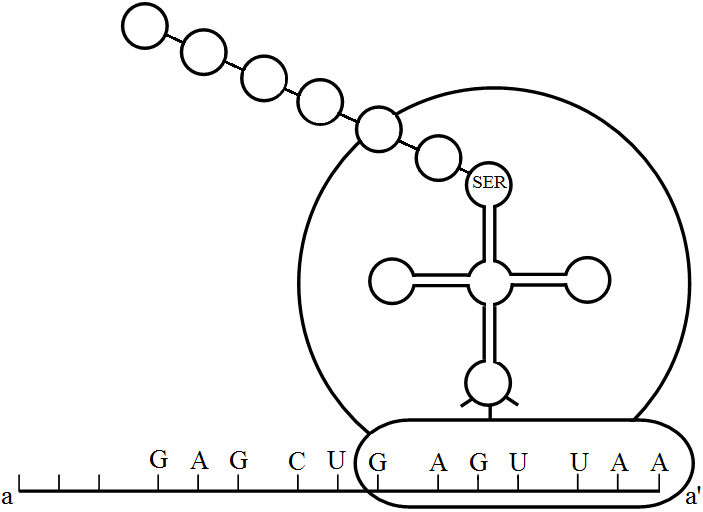
  1. Identify the polarity of strand in the diagram from a to a', and mention how many more amino acids can be expected to be added to this polypeptide chain.
  2. Mention the DNA sequence coding for serine and the anticodon of tRNA for the same amino acid.
  3. Why are some untranslated sequence of bases seen in mRNA coding for a polypeptide?
Where exactly are they present on mRNA?
Explain the changes that milk undergoes when suitable starter/ inoculum is added to it. How does the end product formed prove to be beneficial for human health?
Give reasons: Testes are located outside the body cavity in scrotal sacs.
Explain co-evolution with reference to parasites and their hosts. Mention any four special adaptive features evolved in parasites for their parasitic mode of life.
OR
Explain parasitism and co-evolution with the help of one example of each.
Draw a labelled diagrammatic sectional view of a human seminiferous tubule.