Question
What does atomic radius and ionic radius really mean to you?

Answer

Atomic radius is the radius of an atom. It measures the size of an atom. If the element is a metal, then the atomic radius refers to the metallic radius, and if the element is a non-metal, then it refers to the covalent radius. Metallic radius is calculated as half the internuclear distance separating the metal cores in the metallic crystal. For example, the internuclear distance between two adjacent copper atoms in solid copper is 256 pm. Thus, the metallic radius of copper is taken as.
Covalent radius is measured as the distance between two atoms when they are found together by a single bond in a covalent molecule. For example, the distance between two chlorine atoms in chlorine molecule is 198 pm. Thus, the covalent radius of chlorine is taken as.
Ionic radius means the radius of an ion (cation or anion). The ionic radii can be calculated by measuring the distances between the cations and anions in ionic crystals.
Since a cation is formed by removing an electron from an atom, the cation has fewer electrons than the parent atom resulting in an increase in the effective nuclear charge. Thus, a cation is smaller than the parent atom. For example, the ionic radius of ion is 95 pm, whereas the atomic radius of Na atom is 186 pm. On the other hand, an anion is larger in size than its parent atom. This is because an anion has the same nuclear charge, but more electrons than the parent atom resulting in an increased repulsion among the electrons and a decrease in the effective nuclear charge. For example, the ionic radius of F-ion is 136 pm, whereas the atomic radius of F atom is 64 pm.

Need a full question paper?

Generate a complete, print-ready paper with questions like this in minutes — across 16+ boards, with answer keys.

Start Generating Free

Similar questions

Although geometries of NH3 and H2O molecules are distorted tetrahedral, bond angle in water is less than that of ammonia. Discuss.
Explain Rutherford's nuclear atomic model and also mention its shortcomings.
  1. An athlete is given 100g of glucose of energy equivalent to 1560kJ. He utilises 50% of this gained energy in the event. In order to avoid storage of energy in the body, calculate the weight of water that would need to perspire. The enthalpy of vaporisation of water is 44kJ mol-1.
  2. Compound with carbon-carbon double bond, such as ethylene, C2H4, add hydrogen in a reaction called hydrogenation, C2H4(g) + H2(g) → C2H6(g)

Calculate enthalpy change for the reaction, using the following combustion data,

$\text{C}_2\text{H}_4(\text{g})+3\text{O}_2(\text{g})\overrightarrow{\ \ \ \ \ }\ 2\text{CO}_2(\text{g})+2\text{H}_2\text{O(l)};$ $\Delta_\text{c}\text{H}^\circ=-1401\text{kJ mol}^{-1}\dots(\text{i})$

$\text{C}_2\text{H}_6(\text{g})+\frac{7}{2}\text{O}_2(\text{g})\overrightarrow{ \ \ \ \ \ \ \ }\ 2\text{CO}_2(\text{g})+3\text{H}_2\text{O(l)}$ $\Delta_\text{c}\text{H}^\circ=-1550\text{kJ mol}^{-1}\dots(\text{ii})$

$\text{H}_2(\text{g})+\frac{1}{2}\text{O}_2(\text{g})\overrightarrow{ \ \ \ \ }\ \text{H}_2\text{O(l)};$ $\Delta_\text{c}\text{H}^\circ=-286.0\text{kJ mol}^{-1}\dots(\text{iii})$
i. Which bond is more polar in the following pairs of molecules:
a. $H _3 C - H , H _3 C - Br$
b. $H _3 C - NH _2, H _3 C - OH$
c. $H _3 C - OH , H _3 C - SH$
ii. Explain the principle of paper chromatography.
Write the mechanism of reaction of propene and HBr in presence of peroxide.
Attempt any five of the following:
1. Why are Alkenes called olefins?
2. Convert 1-bromopropane to 2-bromopropane.
3. If Qc < Kc, when we continuously remove the product, what would be the direction of the reaction?
4. Convert methane into ethane.
5. What are cycloalkanes?
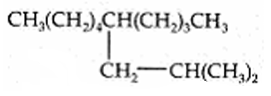
6. Write IUPAC name of following:
Image
7. How will you convert ethanoic acid into ethene?
How do atomic radius vary in a period and in a group? How do you explain the variation?
Explain scientific notation in detail.
Explain the mechanism of halogenation of alkanes.
Write the general outer electronic configuration of s-, p-, d- and f- block elements.