MCQ
What does not change in the field of central force
  • A
    Potential energy
  • B
    Kinetic energy
  • C
    Linear momentum
  • Angular momentum

Answer

Correct option: D.
Angular momentum
d
(d) For central force, torque is zero. 

$\;\tau  = \frac{{dL}}{{dt}} = 0$

$L =$ constant 

i.e. Angular momentum is constant.

Need a full question paper?

Generate a complete, print-ready paper with questions like this in minutes — across 16+ boards, with answer keys.
Start Generating Free

Similar questions

Among the forces in nature, friction can be classified into
If the momentum of a body is increased $n$ times, its kinetic energy increases
The transverse displacement of a string (clamped at its both ends) is given by $\text{y}(\text{x, t})=0.06\sin(1\pi\text{x/ 3})\cos(120\pi\text{t}).$
All the points on the string between two consecutive nodes vibrate with
  1. Same frequency.
  2. Same phase.
  3. Same energy.
  4. Different amplitude.
A large vessel of height $H$, is filled with a liquid of density $\rho$, upto the brim. A small hole of radius $r$ is made at the side vertical face, close to the base. The horizontal force is required to stop the gushing of liquid is ...........
A particle of mass $m$ is projected at an angle $\alpha $ to the horizontal with initial velocity $u\,m/s$ then work done by gravity during the time it reaches its highest point
Two lithium nuclei in a lithium vapour at room temperature do not combine to form a carbon nucleus because:
  1. A lithium nucleus is more tightly bound than a carbon nucleus.
  2. Carbon nucleus is an unstable particle.
  3. It is not energetically favourable.
  4. Coulomb repulsion does not allow the nuclei to come very close.
An object with a mass $10 \,kg$ moves at a constant velocity of $10 \,m/sec$. A constant force then acts for $4\, second$ on the object and gives it a speed of $2\, m/sec$ in opposite direction. The acceleration produced in it, is ........ $m/{\sec ^2}$
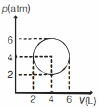
An ideal gas undergoes a circular cycle centred at $4 \,atm , 4 L$ as shown in the diagram. The maximum temperature attained in this process is close to
A shell is fired from a cannon with velocity $v m/sec$ at an angle $\theta $ with the horizontal direction. At the highest point in its path it explodes into two pieces of equal mass. One of the pieces retraces its path to the cannon and the speed in $m/sec $ of the other piece immediately after the explosion is
The equation $y = 0.15\sin 5x\cos 300t$, describes a stationary wave. The wavelength of the stationary wave is .... $m$