Question
What effect does branching of an alkane chain has on its boiling point?

Answer

As the branching in an alkane increases, the shape of the molecule approaches a sphere and size of the branched chain alkane becomes less than that of its straight chain counterpart. The reduced surface area results in decreased van der Waals' interaction and finally leads to lower boiling point as compared to straight chain alkanes of comparable molar mass.

Need a full question paper?

Generate a complete, print-ready paper with questions like this in minutes — across 16+ boards, with answer keys.

Start Generating Free

Similar questions

Melting point, enthalpy of vapourisation and viscosity data of $H_2O$ and $D_2O$ are given below:
 
$H_2O$
$D_2O$
Melting point / K
373.0
374.4
Enthalpy of vapourisation at $(373 K)/ kJ mol^{-1}$
40.66
41.61
Viscosity/ centipoise
0.8903
1.107
On the basis of this data, explain in which of these liquids intermolecular forces are stronger?
Calculate the energy required for the process,
$\text{He}^+(\text{g})\rightarrow\text{He}^{2+}\text{(g)}+\text{e}^-$
The ionization energy for the H atom in the ground state is $2.18 \times 10^{-18} \mathrm{~J}\mathrm{~atom}^{-1}$
Draw the resonating structure of
1. ozone molecule
2. nitrate ion
What would be the SI unit for the quantity $\text{pV}^2\text{T}^2/\text{n}$?
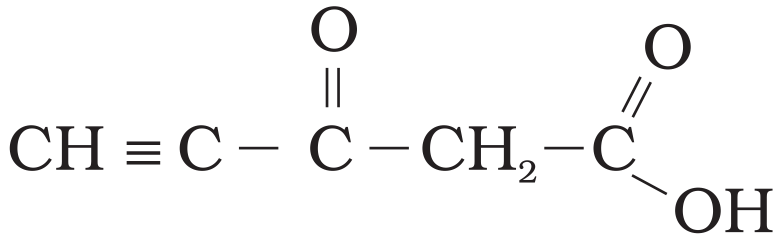
Predict the hybridization of each carbon in the molecule of organic compound given below. Also indicate the total number of sigma and pi bonds in this molecule.
A compound on analysis was found to contain C = 34.6%, H = 3.85%, and 0 = 61.55%. Calculate its empirical formula.
Give reasons for the following:
  1. Elements in the same group have similar physical and chemical properties.
  2. O has lower ionization enthalpy than N.
  3. Noble gases have high positive values of electron gain enthalpies.
What is the relationship between the members of following pairs of structures? Are they structural or geometrical isomers or resonance contributors?
For the reaction, $\mathrm{N}_2(\mathrm{g})+3 \mathrm{H}_2(\mathrm{g}) \rightleftharpoons 2 \mathrm{NH}_3(\mathrm{g})$, the partial pressures of $\mathrm{N}_2$ and $\mathrm{H}_2$ are 0.80 and 0.40 atmosphere respectively at equilibrium. The total pressure of the system is 2.80 atmosphere. What is $\mathrm{K}_{\mathrm{p}}$ for the above reaction?
A mixture of gases containing $\text{H}_2$ and $\text{O}_2$ in the ratio of 1 : 4 by mass. What is their molar ratio.