Question
What is a centromere? How does the position of centromere form the basis of classification of chromosomes. Support your answer with a diagram showing the position of centromere on different types of chromosomes.

Answer

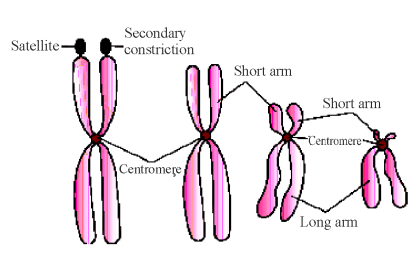
Chromosome (centromere): In every chromosome there is a primary narrowing which is called chromosome point or centromere. Every chromosome (visible only in dividing cells) essentially has a primary constriction or the centromere on the sides of which disc-shaped structures called kinetochores are present. Based on the position of the centromere, the chromosomes can be classified into four types:
(i) Metacentric: In the chromosome, the centromere is located in the middle of the chromosomes, due to which both the arms of the chromosome are of equal length and they are V-shaped.
(ii) Sub-metacentric: The centromere in the chromosome is away from the middle of the chromosome, as a result of which one arm is shorter and the other arm is longer. The shape of chromosome is J or L shaped.
(iii) Acrocentric: In the chromosome, the centromere is found at its very edge, due to which one arm is very small and the other arm is very long.
(iv) Telocentric: Centromere is located at the top of the chromosome.
Image
Fig.: Types of Chromosomes based on the position of Centromere

Need a full question paper?

Generate a complete, print-ready paper with questions like this in minutes — across 16+ boards, with answer keys.

Start Generating Free

Similar questions

Analyse the events during every stage of cell cycle and notice how the following two parameters change: (i) number of chromosomes (N) per cell, (ii) amount of DNA content (C) per cell.
How are viroids different from viruses?
Cell membrane, also called plasma membrane, thin membrane that surrounds every living cell, delimiting the cell from the environment around it. Enclosed by this cell membrane are the cell’s constituents, large, water-soluble, highly charged molecules such as proteins, nucleic acids, carbohydrates, and substances involved in cellular metabolism. Cell membranes are composed primarily of fatty-acid based lipids and proteins. Membrane lipids are principally of two types, phospholipids and sterols (generally cholesterol). Both types share the defining characteristic of lipids—they dissolve readily in organic solvents—but in addition they both have a region that is attracted to and soluble in water.

(1).Plasma membrane is made up of
(a) A protein, a lipid and a cellulose layer
(b) Bimolecular lipid layer surrounded by protein layers
(c) A protein layer between two lipid layers
(d) A lipid layer between two protein layers

(2) Fluid mosaic model of cell was put forward by –
(a) Danielli and Dawson
(b) Singer and Nicolson
(c) Garner and Allard
(d) Watson and Crick

(3) Which of the following statements best describes the chemical composition of
plasma-membrane?
(a) Plasma membrane is composed of two layers—one layer of phospholipids and one layer
of proteins.
(b) Plasma membrane is composed of equal numbers of phospholipids, proteins, and
carbohydrates.
(c) Plasma membrane is bilayers of proteins with associated lipids and carbohydrates.
(d) Plasma membrane is bilayers of phospholipids with associated proteins and
carbohydrates.

(4) Most abundant lipid in the cell membrane is
(a) phospholipids (b) cerebrosides (c) glycolipids (d) None of these
There are thousands of different eubacteria or 'true bacteria'. They are characterized by the presence of a rigid cell wall, and if motile, a flagellum. The cyanobacteria (also referred to as blue-green algae) have chlorophyll a similar to green plants and are photosynthetic autotrophs. The cyanobacteria are unicellular, colonial or filamentous, freshwater/marine or terrestrial algae. The colonies are generally surrounded by gelatinous sheath. They often form blooms in polluted water bodies. Some of these organisms can fix atmospheric nitrogen in specialized cells called heterocysts, e.g., Nostoc and Anabaena. Chemosynthetic autotrophic bacteria oxidise various inorganic substances such as nitrates, nitrites and ammonia and use the released energy for their ATP production. They play a great role in recycling nutrients like nitrogen, phosphorous. iron and Sulphur.

(1) Which of the following can be termed as 'Photosynthetic Autotrophs'
(a) All monerans (b) Chemosynthetic Bacteria (c) Cyanobacteria (d) All Eubacteria

(2) Blue green algae are characterized by :
(a) They often form blooms in polluted water bodies.
(b) Some of these organisms can fix atmospheric nitrogen
(c) Their colonies are generally surrounded by gelatinous sheath.
(d) All of these

(3) Which is incorrect about Heterocysts:
(a) These are specialized cells
(b) These are present in all Cyanobacteria.
(c) Nostoc and Anabaena have Heterocysts.
(d) Organisms having these cells can fix atmospheric nitrogen

(4) Green plants are similar to Blue green algae in having:
(a) chlorophyll a (b) Heterocysts (c) chlorophyll b (d) None of these

(5) Which of these can be described as ‘true Bacteria’.
(a) Cyanobacteria only
(b) Only Chemosynthetic autotrophic bacteria
(c) Bacteria without cell wall.
(d) Eubacteria
What is called endoplasmic reticulum? Write any four differences between smooth endoplasmic reticulum and rough endoplasmic reticulum.
Lipids form a heterogeneous group but all are made up of carbon hydrogen and oxygen. These are insoluble in water and soluble in organic solvents like acetone, ether, alcohol etc. The number of oxygen atoms is very small compared to carbon atoms. They need a large amount of oxygen for their oxidation to release energy. They could be simple lipids, compound lipids, and derived lipids. Simple lipids are esters of fatty acid and alcohol. Compound lipids are formed when simple lipids combine with another compounds for example glycolipids, phospholipids and lipoproteins. Derived lipids are of various types and important example being steroids.

(1) Lipids mainly consist of
(a) Carbon only
(b) carbon hydrogen and nitrogen
(c) carbon hydrogen and oxygen
(d) Hydrogen only

(2) Among the given options non-polymeric molecule is
(a) Nucleic acids (b) proteins (c) Lipids (d) polysaccharides

(3) An example of unsaturated fatty acid is
(a) oleic acid (b) stearic acid (c) Linoleic acid (d) both a and c

(4) The number of carbon atoms as compared to oxygen atoms in lipids is
(a) same (b) much less (c) much more (d) none of these.

(5) Steroids are an example of
(a) derived lipids (b) conjugated lipids (c) simple lipids (d) lipo proteins
Briefly describe any four valves found in the human heart. Make labelled diagram of a cross section of a human heart.
Make a labelled diagram of Funaria, Gametophyte and Sporophyte. Write any three differences between gymnosperms and angiosperms.
Organise a discussion in your class on the topic-Are viruses living or non-living?