Maharashtra BoardEnglish MediumSTD 12 SciencePhysicsQuestion Bank [ 2022 ]4 Marks
Question
What is a conical pendulum? Obtain an expression for its time period
✓
Answer
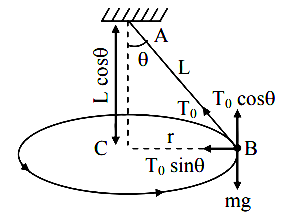
A tiny mass (assumed to be a point object and called a bob) connected to a long, flexible, massless, inextensible string, and suspended to rigid support revolves in such a way that the string moves along the surface of a right circular cone of the vertical axis and the point object performs a uniform horizontal circular motion. Such a system is called a conical pendulum.
Expression for its time period:
i. Consider the vertical section of a conical pendulum having bob (point mass) of mass $m$ and string of length ' $L$ '.
Here, $\theta$ is the angle made by the string with the vertical, at any position (semi-vertical angle of the cone)
ii. In a given position $B$, the forces acting on the bob are
a. its weight ' $m g$ ' directed vertically downwards
b. the force ' $T T_0$ ' due to the tension in the string, directed along the string, towards the support A.
In an inertial frame
iii. As the motion of the bob is a horizontal circular motion, the resultant force must be horizontal and directed towards the centre $C$ of the circular motion.
For this, tension $\left(T_0\right)$ in the string is resolved into
a. $T _0 \cos \theta$ : vertical component
b. $T_0 \sin \theta$ : horizontal component
iv. The vertical component $\left(T_0 \cos \theta\right)$ balances the weight ' $m g$ '.
$\therefore mg = T _0 \cos \theta$
The horizontal component $T _0 \sin \theta$ then becomes the resultant force which is centripetal.
$m r \omega^2=T_0 \sin \theta$
Dividing equation (2) by equation ( 1 ),
$\omega^2=\frac{g \sin \theta}{r \cos \theta}$
v. From the figure,
$ \sin \theta=\frac{r}{L}$
$\therefore r=L \sin \theta $
From equation (3) and (4),
$ \omega^2=\frac{g \sin \theta}{L \cdot \sin \theta \cdot \cos \theta}$
$\omega=\sqrt{\frac{g}{L \cos \theta}} $
vi. If $T$ is the period of revolution of the bob, then
$ \omega=\frac{2 \pi}{T}=\sqrt{\frac{g}{L \cos \theta}}$
$\therefore \text { Period, } T=2 \pi \sqrt{\frac{L \cos \theta}{g}} $
Need a full question paper?
Generate a complete, print-ready paper with questions like this in minutes — across 16+ boards, with answer keys.