Question
What is a constellation? Name any two constellations.

Answer

The stars forming a group that has a recognisable shape is called a constellation. We can easily identify them in the night sky. Ursa Major and Orion are the examples of the constellations. Ursa Major is the constellation which reminds us of a large ladle or a question mark in the night sky. It is also known as the Big Dipper, the Great Bear or the Saptarshi. There are seven prominent stars in this constellation. It appears like a big ladle or a question mark. The constellation Orion is visible during winter in the late evenings. It also has seven or eight bright stars. It is also called the Hunter. The three middle stars represent the belt of the hunter. The four bright stars appear to be arranged in the form of a quadrilateral.

Need a full question paper?

Generate a complete, print-ready paper with questions like this in minutes — across 16+ boards, with answer keys.
Start Generating Free

Similar questions

Explain why, fossil fuels are exhaustible natural resources.
How does deforestation cause soil erosion?
What are the constituents of coal gas? State one use of coal gas.
State two differences between the artificial satellites of the Earth and its natural satellite Moon.
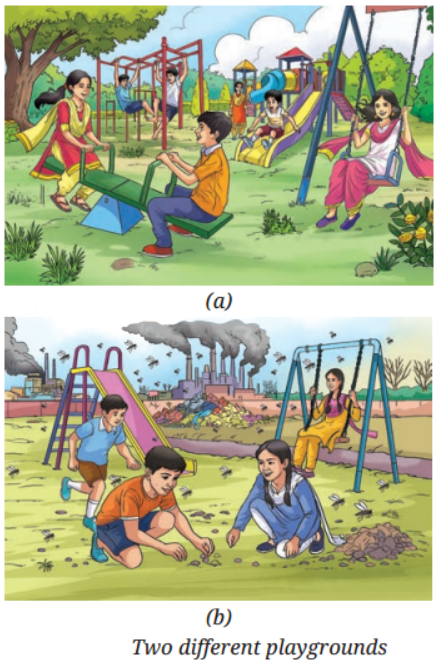
Look at Fig. (a) and Fig. (b). Which playground would you like to play in, and why?
Image
If wheat is sown in the kharif season, what would happen? Discuss.
Read the paragraph and answer the questions following it. Water is essential for life. Without water there would be no life. We usually take water as granted for its purity, but we must ensure the quality of water. Pollution of water originates from human activities. Through different paths, pollution reaches to
ground water. Easily identified source or place of pollution is called as point source, e.g.– municipal and industrial discharge pipes, where pollutants enter the water source. Non–point sources of pollution are those where a source of pollution can not be easily identified, e.g.– agricultural run off, acid rain etc.
$i.$ How do you classify the various sources of water pollution?
$ii.$ What are the point sources of water pollution?
$iii.$ Name any two non-point sources of water pollution?
Man, A has a defect of vision due to which he cannot see the nearby objects clearly $($though he can see the distant objects clearly$).$ On the other hand, man $B$ has a defect of vision due to which he cannot see the distant object clearly $($though he can see the nearby objects clearly$)$. The defect in man $A$ can be corrected by using spectacles containing lenses $C$ whereas the defect in man $B$ can be corrected by using spectacles containing lenses $D.$
$a.$ Name the defect of vision in man $(i) A$, and $(ii) B.$
$b.$ What type of lenses are $(i) C$, and $(ii) D?$
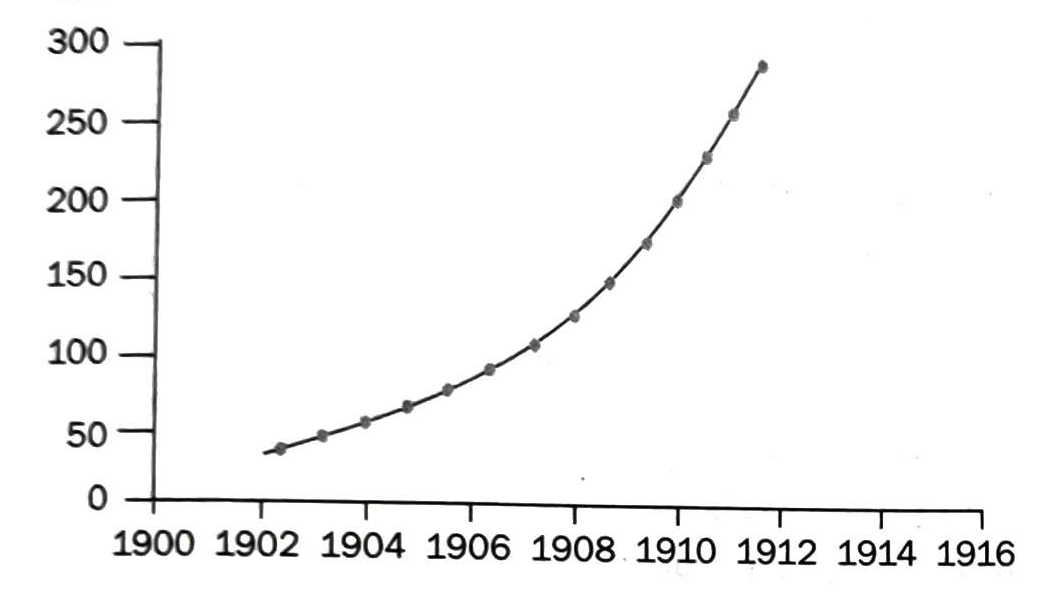
Analyse a set of data on the population trends of species over a bison few years. What patterns can be identified from the graph below about the growth of bison? Also mention where the threatened species are protected.
Image
Suppose the moon emits light of its own. Would it still have phases? Justify your answer.