Question
What is a filter circuit? Explain its functioning.

Answer

The rectified voltage is in the form of pulses of the shape of half sinusoilds. Though, it is unidirectional it does not have a steady value.
To get steady dc output from pulsating voltage, the filter circuit is used. Filter circuits consist of only capacitor, only inductor or a combination of both. Since these additional circuits appear to filter out the ac ripple and give a pure dc voltage, so they are called filters.
• Functioning of a Filter Circuit :
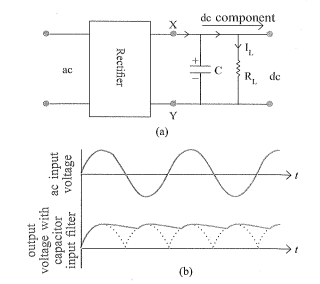
When the voltage across the capacitor is rising, it gets charged. If there is no external load, it remains charged to peak voltage of the rectified output.
When there is a load, it gets discharged through the load and the voltage across it begins to fall. In the next half cycle of rectified output it again gets charged to the peak value.
As shown in the fig., the rate of fall of the voltage across capacitor depends on the inverse product of capacitor C and the effective resistance $R_L$ used in the circuit and is called the time constant. To make the time constant large, value of C should be large. So capacitor input filters use large capacitors.
The output voltage obtained by using capacitor input filter is nearer to the peak voltage of the rectified voltage.
This type of filter is most widely used in power supplies.
Image

Need a full question paper?

Generate a complete, print-ready paper with questions like this in minutes — across 16+ boards, with answer keys.
Start Generating Free

Similar questions

A boy is standing on a platform which is free to rotate about its axis. The boy holds an open umbrella in his hand. The axis of the umbrella coincides with that of the platform. The moment of inertia of ''the platform plus the boy system'' is 3.0 × 10⁻³kg-m2 and that of the umbrella is 2.0 × 10³kg-m2. The boy starts spinning the umbrella about the axis at an angular speed of 2.0rev/s with respect to himself. Find the angular velocity imparted to the platform.
A barometer is constructed with its tube having radius 1.0mm. Assume that the surface of mercury in the tube is spherical in shape. If the atmospheric pressure is equal to 76cm of mercury, what will be the height raised in the barometer tube. The contact angle of mercury with glass = 135º and surface tension of mercury = 0.465N/m. Density of mercury = 13600kg/m3.
A proton and an a particle are accelerated through the same potential difference. Which one of the two has (i) greater de-Broglie wavelength, and (ii) less kinetic energy? Justify your answer.
Illustrate by drawing the helical motion of a charged particle in a uniform magnetic field and derive the equations of pitch and radius of helix.
###
Discuss the path of motion of a charged particle entering with velocity at angle $\theta$ with uniform magnetic field. (where $\theta \neq 0, \frac{\pi}{2}, \pi$ )
Write two differences between charge and mass.
What does the equivalence / similarity of magnetic field lines of a bar magnet and a solenoid indicate (suggest)?
A parallel beam of light of wavelength 500 nm falls on a narrow slit and the resulting diffraction pattern is observed on a screen 1 m away. It is observed that the first minimum is at a distance of 2.5 mm from the centre of the screen. Find the width of the slit.
Answer the following:
The discharging current in the atmosphere due to the small conductivity of air is known to be 1800A on an average over the globe. Why then does the atmosphere not discharge itself completely in due course and become electrically neutral? In other words, what keeps the atmosphere charged?
50m3 of saturated vapour is cooled down from 30°C to 20°C. Find the mass of the water condensed. The absolute humidity of saturated water vapour is 30gm-3 at 30°C and 16gm-3 at 20°C.
Explain how current is formed in conductors.