Question
What is a galvanometer used for? Explain in brief the working of a galvanometer.

Answer

Galvanometer is a sensitive device used to detect the presence of current in a circuit as well as to determine the direction of the current in the circuit.

With suitable modification, it can be used to measure charge, current and voltage. Its working is based on the same principle as that of an electric motor. Here, a coil is pivoted (or suspended) between the pole pieces of a magnet and a pointer is connected to the coil. As the coil rotates when a current is passed through it, the pointer also rotates. The rotation of the coil and hence the deflection of the coil is proportional to the current. The pointer deflects on both sides of the Central zero mark depending on’ the direction of the current.

Need a full question paper?

Generate a complete, print-ready paper with questions like this in minutes — across 16+ boards, with answer keys.
Start Generating Free

Similar questions

Complete the paragraph with the help of words given in the bracket:
(nutritive, ethanol, salt, actinomycetes, fermentation, carbon dioxide, lactic acid, Saccharomyces cerevisiae)
Different types of breads are produced from flour of cereals. Dough is formed by mixing of baker's yeast - __________ , water, __________ and other necessary materials with flour. Due to __________ of carbohydrates by yeast, sugar is __________ and __________ . Dough converted into rises up due to $CO _2$ and the bread becomes spongy. Bread and other products produced with the help of yeast become __________ .
How much time would a satellite in an orbit at a height of $35780$ km above the earth’s surface take to complete one revolution around the earth, if the mass of the earth were four times its original mass?
Define the refractive index of the second medium with respect to the first medium.
(OR)
What is meant by refractive index?
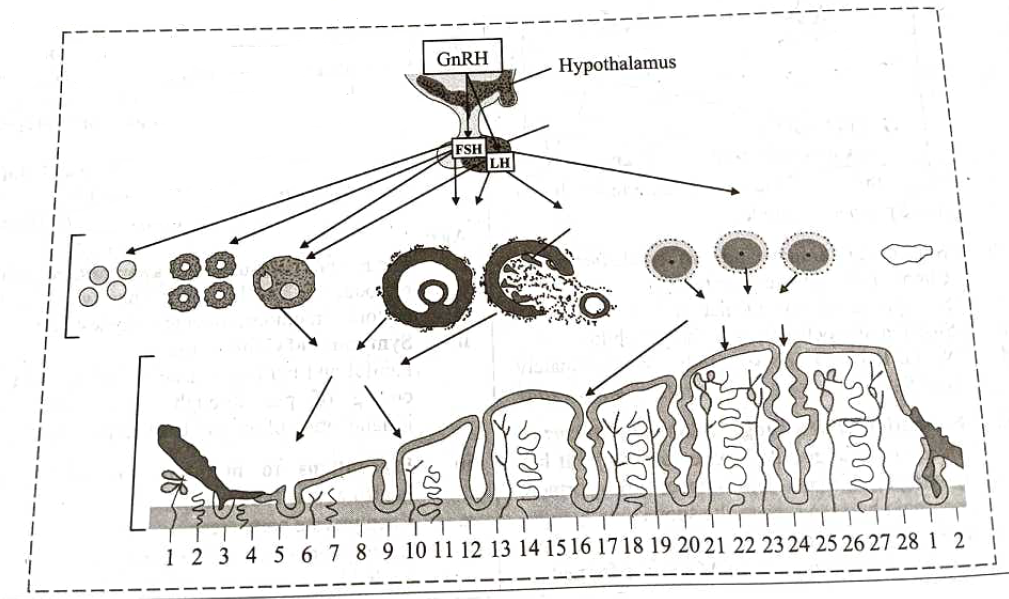
Observe the figure and answer the questions:
Image
i. Identify the process in above figure and after how many days it will repeat again?
ii. Write the names of hormones involved in this process.
Note the relationship between the entries in all the three columns in the table and rewrite the table.
Column-1
(Location)
Column-2
Height from the earth’s surface (km)
Column$-3$
$g (m/s^2)$
Earth’s surface (average) $8.8$ $0.225$
Mount Everest $36.6$ $9.81$
Maximum height ever reached by manmade balloon $400$ $9.8$
Orbit of a typical weather satellite $35700$ $9.77$
Orbit of communication satellite $0$ $8.7$
Calculate the escape velocity on the surface of the moon given the mass and radius of the moon to be $7.34 \times 10^{22} kg$ and $1.74 \times 10^6 m$ respectively. $($Given: $G=6.67 \times 10^{-11} Nm ^2 / kg ^2 ).$
Write the characteristics of vertebrates.
What is meant by strong bases and weak bases$?$ Classify the following into strong bases and weak bases:
$NH_4OH, Ca(OH)_2, NaOH, KOH, Mg(OH)_2$ 
Two lenses A and B have power of (i) + 2 D and (ii) -4D respectively. What is the nature and focal length of each lens?
i. Define vestigial organs.
ii. Write names of any two vestigial organs in the human body.
iii. Write name of those animals in which these vestigial organs are functional.