Question
What is a perfect blackbody ? How can it be realized in practice?

Answer

A perfect blackbody or simply a blackbody is defined as a body which absorbs all the radiant energy incident on it.

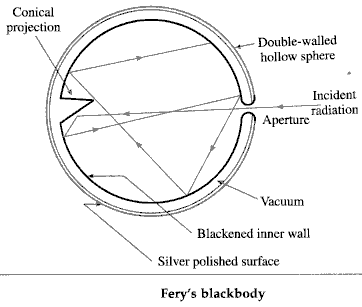
Fery designed a spherical blackbody which consists of a hollow double-walled, metallic sphere provided with a tiny hole or aperture on one side, in below figure. The inside wall of the sphere is blackened with lampblack while the outside is silver-plated. The space between the two walls is evacuated to minimize heat loss by conduction and convection.

Any radiation entering the sphere through the aperture suffers multiple reflections where about 97% of it is absorbed at each incidence by the coating of lampblack. The radiation is almost completely absorbed after a number of internal reflections. A conical projection on the inside wall opposite the hole minimizes probability of incident radiation escaping out.
Image

When the sphere is placed in a bath of suitable fused salts, so as to maintain it at the desired temperature, the hole serves as a source of black-body radiation. The intensity and the nature of the radiation depend only on the temperature of the walls.

A blackbody, by definition, has coefficient of absorption equal to 1. Hence, its coefficient of reflection and coefficient of transmission are both zero.

The radiation from a blackbody, called blackbody radiation, covers the entire range of the electromagnetic spectrum. Hence, a blackbody is called a full radiator.

Need a full question paper?

Generate a complete, print-ready paper with questions like this in minutes — across 16+ boards, with answer keys.
Start Generating Free

Similar questions

What is meant by coherent sources? What are the two methods for obtaining coherent sources in the laboratory?
A horizontal force of $1 N$ is required to move a metal plate of area $10^{-2} m ^2$ with a velocity of $2 \times 10^{-2} m / s$, when it rests on a layer of oil $1.5 \times 10^{-3} m$ thick. Find the coefficient of viscosity of oil.
Define an ideal simple pendulum. Show that the motion of a simple pendulum under certain conditions is simple harmonic. Obtain an expression for its period.
Four particles of masses 0.2 kg, 0.3 kg, 0.4 kg and 0.5 kg respectively are kept at comers A, B, C and D of a square ABCD of side 1 m. Find the moment of inertia of the system about an axis passing through point A and perpendicular to the plane of the square.
What is the electric potential energy of the following charge configuration? Take $q_1=+1 \times 10^{-8} C _1 q _2=-2 \times 10^{-8} C , q _3=+3 \times 10^{-8} C , q _4=2 \times 10^{-8} C$ and $a =1 m$. Assume the charges to be in vacuum.
Image
Derive the relation between the surface tension and surface energy of a liquid.
OR
Derive the relation between surface tension and surface energy per unit area.
OR
Show that the surface tension of a liquid is numerically equal to the surface energy per unit area.
Distinguish between centripetal force and centrifugal force. State any two points of distinction.
Explain aerodynamic lift on the wings of an aeroplane.
OR
Explain why the upper surface of the wings of an aeroplane is made convex and the lower surface concave.
What is an ideal solenoid?
Magnetic Resonance Imaging (MRI) technique used for medical imaging requires a magnetic field with a strength of 1.5 T and even upto 7 T. Nuclear Magnetic Resonance experiments require a magnetic field upto 14 T. Such high magnetic fields can be produced using superconducting coil electromagnet. On the other hand, Earth’s magnetic field on the surface of the Earth is about $3.6 \times 10^{-5} T = 0.36$ gauss.