Question
What is a region?

Answer

  • A region is an area of a country or any part of the world having common features. Thus, there is a difference between two regions on the basis of its features.
  • The common features may be physical (relief, climate, soil, natural vegetation, etc.), socio¬cultural factors (language, religion, etc.), man-made like political features (administrative or political boundaries).
  • Regions may be small or large. The large regions include sub-regions. For example, the plateau region of India has various sub-regions such as Chota Nagpur plateau, Malwa plateau, Marwar plateau, Deccan plateau, etc.

The main characteristics of regions are :

  • Regions have its geographical location mentioned in latitudes and longitude.
  • Every region has a specific boundary, the area of another region starts beyond that boundary.
  • The extent of a region depends upon the homogeneity of a region.
  • There are sub-regions in one region and therefore regions can be arranged into different orders on the basis of same features.

There are two types of regions – formal and functional regions.
1. A formal region is also known as uniform region or homogeneous region. It is an area in which everyone shares in common one or more distinctive characteristics. It can be common physical characteristic such as relief or climate of the region. It can be socio-cultural or economic activity such as common language. For example, rice producing regions.

2. In some formal regions, there are boundaries. Thus, district, state or country may be formal region. For example, USA and Canada are the examples of formal regions.

3. In functional regions characteristics are not important but functions are more important.

4. In one functional region, there may be many political or physical regions but due to one common function it is said to be functional. For example, Mumbai metropolitan or Pune metropolitan regions.

5. Functional regions act as a focal point that connects surrounding areas by transportation and communication. For example, Mumbai metropolitan city is well connected with its surrounding areas through transportation.

Need a full question paper?

Generate a complete, print-ready paper with questions like this in minutes — across 16+ boards, with answer keys.
Start Generating Free

Similar questions

In the first and fifth stage of the demographic transition, population growth is almost nil. What is the difference between the two stages then?
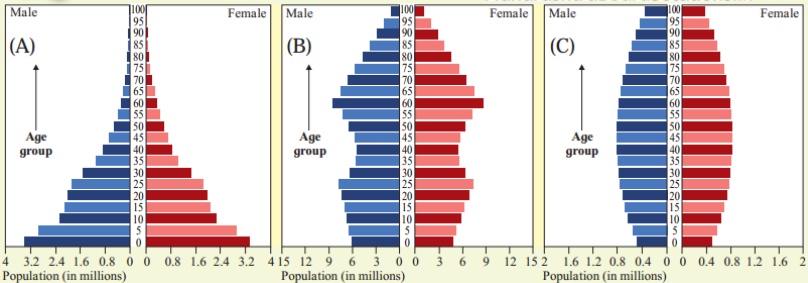
Image
(1)In the above figure A, B, C are three population pyramids. Study their shapes and answer the following questions.
(i) In which pyramid(s) the number of children will be the least?
(ii) In which pyramid(s) the number of old people will be the least?
(iii) Which pyramid(s) represents a ‘young country’?
(iv) Which pyramid(s) represents a country with high medical expenditure?
(v) Which pyramid(s) represents a country with large manpower?
(vi) Which pyramid(s) represents developing and developed counties respectively?
(2)Answer the questions after studying table carefully.
Country Retirement Age reforms being implemented or under consideration (in years)
Germany Retirement age to increase gradually to 66 by 2023 and to 67 by 2029
United States of America Retirement age to rise gradually to reach 67 for those born in 1960 or later
United Kingdom Retirement age to increase for both men and women to 66 by October 2020 and further to 67 between 2026-28
Australia Retirement age scheduled to increase gradually to 67 by 2023
China By 2045, to increase retirement age for both men and women to 65
Japan Under consideration to raise the retirement age to 70
India On an average, 60 years. May vary from 55 years to 65 years according to services
(i) What does the table show?
(ii) Classify these countries into developed and developing.
(iii) What could be the reason behind increasing the retirement age in these countries?
(iv) What will be the impact of increase in the retirement age on the economy of the respective countries?
(v) Why is China considering increasing the age later in 2045?
(vi) Considering these examples from developed countries, will it be good for India to increase its retirement age? Express your views.
(vii) Write a concluding statement about the relationship between age structure, life expectancy and economy of a country.
(3)You have already made a list of the reasons why migration occurs. Add more reasons to it. Discuss and classify these reasons into pull and push factors and complete the figure.
(4)Complete the following table which shows impact of migration on the population.
Type of migration Positive effects Negative effects
Internal migration Employment is available to migrants. Improves their financial status. Resources are affected. Sometimes, they might be sent back to their original country.
Rural to urban migration
Urban to rural migration
Rural to rural
Seasonal / Temporary
Write a note on Intensive Subsistence agriculture.
With the help of internet, find out about Wild Life (Conservation) Act.
What factors are responsible for development of various patterns in settlement? Give examples.
What is the difference between fishing and pisciculture?
Explain how the knowledge of Geography is important in our day-to-day life. Give examples.
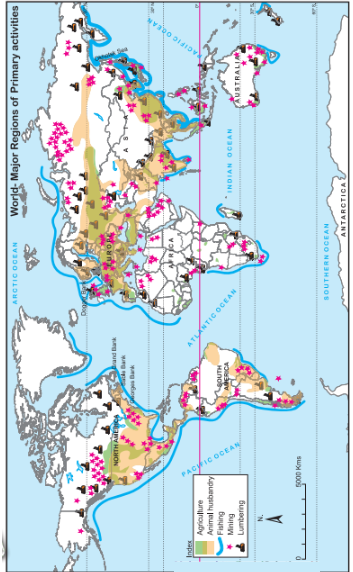
Look at the Fig. and answer the following questionsImage
(i) In which part of the North American continent is mining mainly found?
(ii) Mining activity is located along which coastal side of South America?
(iii) Comparing other primary economic activities, do you think the extent of mining is related to latitude.
(iv) Looking at the concentration of mining in the world, can you relate it with the economic development of the country?
Write in detail about the characteristics of primary economic activities.
Write a note on the areas in the world practicing commercial animal husbandry.