Question
What is a share? State the types of shares.

Answer

Capital which can be divided into transferable small denominations which are known as share. According to companies act, a company may issue two types of shares :
$(i)$ Equity share
$(ii)$ Preference shares.$(i)$ Equity shares: The shares which are not preference shares are known as equity shares. Equity share capital is known as principal share capital of the company. Equity shareholders have voting rights and right to participate in management of the company. At the time of liquidation, equity shareholders gets amount after complete payment to preference shareholders. Company gives dividends on equity shares every year on the basis of current year’s profit.
$(ii)$ Preference shares: Preference share is one which gives preferential right to its holder for receiving the dividend at a special rate before any dividend paid to equity shareholders.
Types of preference shares are as under :
$(1)$ Cumulative preference shares: In case of cumulative preference shares, arrears of dividend shall be paid together with current year’s dividend in the year when there is sufficient profit.
$(2)$ Non-cumulative preference shares: In case of non-cumulative preference shares, such arrears of dividend are not accumulated and are not paid in future.
$(3)$ Redeemable and Irredeemable preference shares: If the amount of preference share is to be repaid by the company at the end of stipulated period, such shares are called
redeemable preference shares. A preference share which can be redeemed only at the time of liquidation of company are called irredeemable preference shares.
$(4)$ Participating and Non-participating preference shares: Preference shareholders who hold participating preference shares get fixed rate of dividend as decided by the company.
In addition to this, they also have a right to participate dividend to equity shareholders subject to terms of participation. Preference shareholders of non-participating preference shares get only a fixed rate of dividend and do not carry a right to participate in the surplus profit or in any surplus capital.
$(5)$ Convertible and Non-convertible preference shares: The preference shares which can be converted partly or fully into equity shares as per agreed terms at the time of issue are known as convertible preference shares. The preference shares which are not convertible into equity shares are known as non-convertible preference shares.

Need a full question paper?

Generate a complete, print-ready paper with questions like this in minutes — across 16+ boards, with answer keys.
Start Generating Free

Similar questions

Write a note of 'Debentures issued at a discount'.
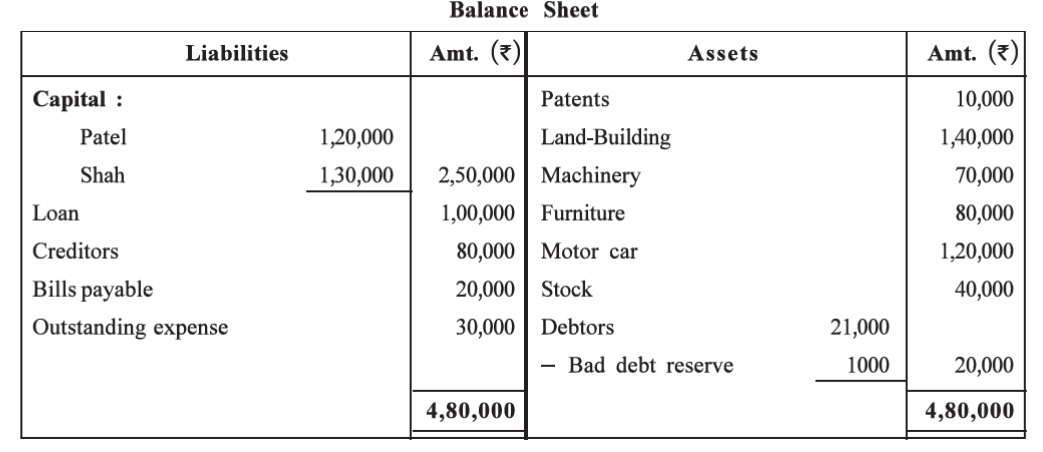
Patel and Shah are partners in a firm sharing profit and loss in the ratio of $3:2.$ The balance sheet of their firm as on $31-3-2016$ was as under:
They admitted Raval as a new partner for th share from $1-4-2016.$ Raval brought $₹ 2,00,000$ as his capital. The partners decided to revalue assets and liabilities as follows:
$(1)$ Land-building is to be appreciated by $20\%.$
$(2)$ Machinery is to be depreciated by $10\%.$
$(3)$ Furniture is valued at $₹ 60,000.$
$(4)$ Motor car is to be depreciated by $20\%.$
$(6)$ Patents are valueless.
$(5)$ A provision for doubtful debt is to be kept at $₹ 5000.$

 
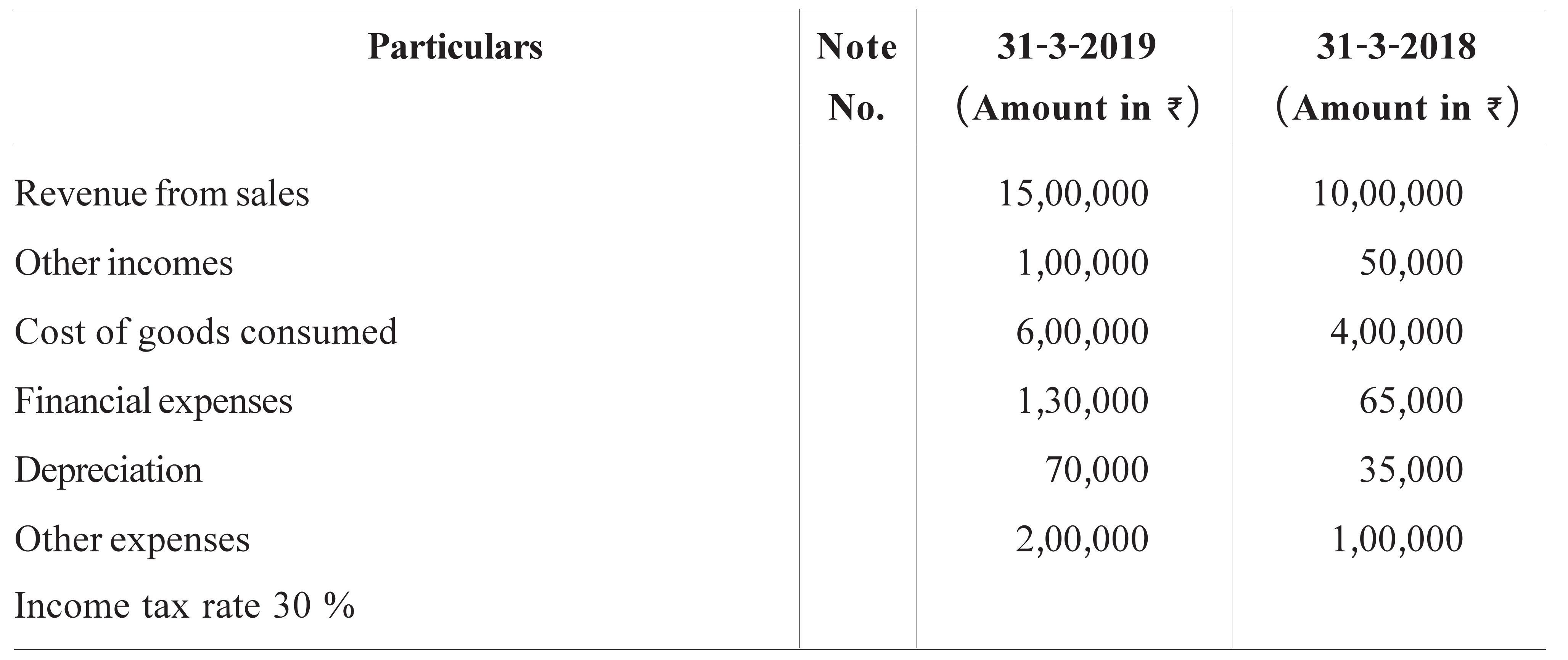
A summarised profit and loss statements for the year ending on $31-3-2018$ and $31-3-2019$ of Bharat Ltd. are as follows. From it prepare comparative profit-loss statement :Profit-loss statement of year ending as on $31-3-2018$ and $31-3-2019$
Pass necessary journal entries for the following transaction of firm in the case of firm's dissolution :
$1.$ At the time of dissolution total assets of the firm are $₹ 5,00,000$. Out of that $40 \%$ are current assets in which cash included is $₹ 20,000$. Fixed assets are realised at $120 \%$ and $80 \%$ realised from current assets.
$2.$ At the time of dissolution; creditor Pankaj was $₹ 35,000 .$ Unrecorded furniture of $₹ 20,000$ given to him and remaining amount paid in cash.
$3.$ After making payment of all liabilities and loan of partners of firm. Surplus of assets is $₹ 1,50,000$. The profit and loss sharing ratio of partners $X, Y$ and $Z$ are $5:3:2.$ Pass entry for its realisation.
$A$ and $B$ are the partners in a firm sharing profit and loss in the ratio of $2: 1$. They admitted $C$ as a new partner for $\frac{1}{3}$ rd share in the profit of the firm. C brought $₹ 70,000$ as capital and $₹ 30,000$ as premium for goodwill in cash. Goodwill of the firm valued at $₹ 1,20,000$ at the time of admission of a new partner. Goodwill appeared in the balance sheet of A and B at $₹ 60,000$. New profit sharing ratio of all three partners is to be $1: 1: 1$.
From the following information prepare comparative profit-loss statement :
Particulars $31-3-2019 (₹)$ $31-3-2018 (₹)$
Sales revenue $30,00,000$ $18,00,000$
Net purchase for resale $18,00,000$ $12,00,000$
Changes in stock $1,00,000$ $1,00,000$
Other expenses    
$(\%$ of cost of sales$)$ $10\%$ $12\%$
Income-tax $30\%$ $30\%$
From the following transactions of Sweta Company Ltd. Calculate cash flow from operating activities :
Particulars $(₹)$
Profit before taxes $1,32,000$
Goodwill written of $28,000$
Patent amortized $17,000$
Depreciation written of $29,000$
Transfer to general reserve $23,000$
Interest received $12,000$
Dividend received $9,000$
Interest paid $11,000$
Dividend paid $25,000$
Profit on sale of investments $13,000$
Loss on sale of furniture $18,000$
From the following transactions calculate cash flow from operating activities :
Particulars $(₹)$
Profit before taxes $99,000$
Income tax provision $29,000$
Proposed dividend $39,000$
Depreciation $22,000$
Dividend received $21,000$
Interest received $20,000$
Interest paid $28,000$
Goodwill written off
Profit on sale of asset
$15,000$
$12,000$
Which kind of activity is the payment of underwritting commission? Why?
Complete the comparative statement of balance sheets of Reshma Company Limited for the year ending on $31-3-2016$ and $31-3-2017.$
Particulars Note
No.
$2$
$31-3-2016$
$(₹)$
$3$
$31-3-2017$
$(₹)$
$4$
Increase/
Decrease $(₹)$
$5(4-3)$
Increase/
Decrease (%)
$6\left(\frac{5}{3} \times 100\right)$
$(I)$ Equity and Liabilities          
$(1)$ Shareholders' funds :          
  $(a)$ Share capital          
  $(i)$ Equity share capital   $?$ $12,00,000$ $?$ $20$
  $(ii)$ Preference share Capital   $?$ $10,50,000$ $?$ $50$
  $(b)$ Reserves and surplus   $?$ $5,00,000$ $?$ $66.67$
$(2)$ Non-current liabilities          
  $10\%$ debentures   $?$ $4,50,000$ $?$ $12.5$
$(3)$ Current liabilities   $?$ $2,00,000$ $?$ $33.33$
  Total   $?$ $34,00,000$ $?$ $33.33$
$(II)$ Assets :          
$(1)$ Non-current assets :          
  $(a)$ Fixed assets          
  $(i)$ Tangible assets   $12,00,000$ $?$ $?$ $41.67$
  $(ii)$ Intangible assets   $11,00,000$ $?$ $?$ $18.18$
$(2)$ Current assets   $2,50,000$ $?$ $?$ $60$
  Total   $25,50,000$ $?$ $?$ $33.33$