Question
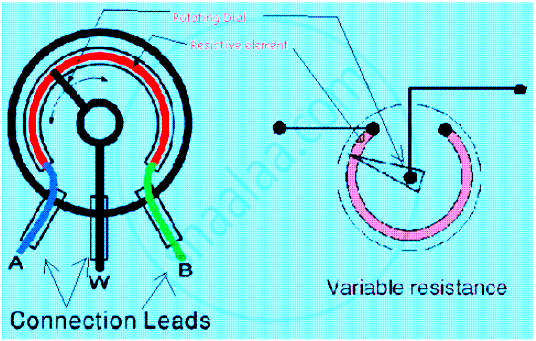
What is a variable resistance? Explain its function using a labeled diagram.

Answer

Variable resistors consist of a resistance track with connections at both ends and a wiper which moves along the track as you turn the spindle. The track may be made from carbon, cermet (ceramic and metal mixture), or a coil of wire (for low resistances). The track is usually rotary but straight track versions, usually called sliders, are also available.
Variable resistance is a device used to change the resistance and hence the current flowing through a circuit; without changing the voltage.

Need a full question paper?

Generate a complete, print-ready paper with questions like this in minutes — across 16+ boards, with answer keys.
Start Generating Free

Similar questions

QUESIION Assuming the density of air to be $1.295 kg m ^{-3}$, find the fall in barometric height in mm of Hg at a height of 107 m above the sea level. Take density of mercury $=13.6 \times 10^3 kg m ^{-3}$.
A cylinder made of copper and aluminium floats in mercury of density $13.6 gem ^{-3}$, such that 0.26 th part of it is below mercury. Find the density of solid.
 A pebble is dropped freely in a well from its top. It takes 20 s for the pebble to reach the water surface in the well. Taking g $=10 m s ^{-2}$ and speed of sound $=330 m s ^{-1}$. Find: The time when echo is heard after the pebble is dropped.
A ball is thrown upward and reaches a maximum height of $19.6 \ m$. Find its initial speed?
Describe an experiment to demonstrate the thermal expansion of solids.
A block of iron of mass 7.5 kg and of dimensions $12 cm \times 8 cm \times 10 cm$ is kept on a table top on its base of side $12 cm \times 8 cm$. Calculate :
  1. Thrust and
  2. Pressure exerted on the table top
Take $1 kgf = 10 N.$
Arrange the following speeds in the increasing order:
(i) A bicycle moving with a speed of 36 km/h.
(ii) A car moving with a speed of 2 km/min.
(iii) An athlete running with a speed of 7 m/s.
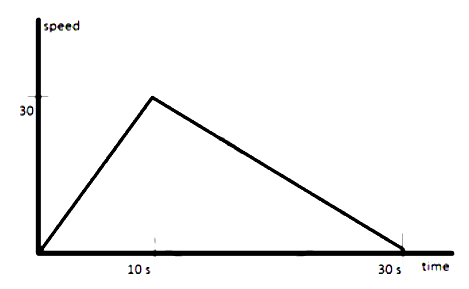
A car accelerates to a velocity of 30 m/s in $10 \ s$ and then decelerates for $20 \ s$ so that it stops. Draw a velocity-time graph to represent the motion and find:
The acceleration.
A cyclist driving at $36 kmh ^{-1}$ stops his motion in 2 s , by the application of brakes. Calculate
1. retardation
2. distance covered during the application of brakes.
What social initiatives must be taken for the sensitive use of energy?