Question
What is a voltmeter? How can a galvanometer be converted into a voltmeter of given range? Explain.
Answer

SELF

Need a full question paper?

Generate a complete, print-ready paper with questions like this in minutes — across 16+ boards, with answer keys.

Start Generating Free

Similar questions

A point charge causes an electric flux of $–1.0 \times 10^3 Nm^2 /C$ to pass through a spherical Gaussian surface of $10.0 \ cm$ radius centred on the charge.
  1. If the radius of the Gaussian surface were doubled, how much flux would pass through the surface?
  2. What is the value of the point charge?
(i) Which mode of propagation is used by short wave broadcast services having frequency range from a few MHz to 30 MHz? Explain diagrammatically how long distance communication can be achieved by this mode.
(ii) Why is there an upper limit to frequency of waves used in this mode ?
Consider the Atwood machine of the previous problem. The larger mass is stopped for a moment $2.0s$ after the system is set into motion. Find the time elapsed before the string is tight again.
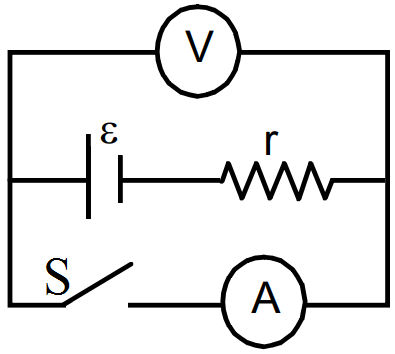
Figure. shows an arrangement to measure the emf $\epsilon$ and internal resistance r of a battery. The voltmeter has a very high resistance and the ammeter also has some resistance. The voltmeter reads 1.52V when the switch S is open. When the switch is closed, the voltmeter reading drops to 1.45V and the ammeter reads 1.0A. Find the emf and the internal resistance of the battery.
An electric dipole of dipole moment $\vec{\text{P}}$ is placed in a uniform electric field $\vec{\text{E}}.$ Write the expression for the torque $\vec\tau$ experienced by the dipole. Identify two pairs of perpendicular vectors in the expression. Show diagrammatically the orientation of the dipole in the field for which the torque is (i) Maximum (ii) Half the maximum value (iii) Zero.
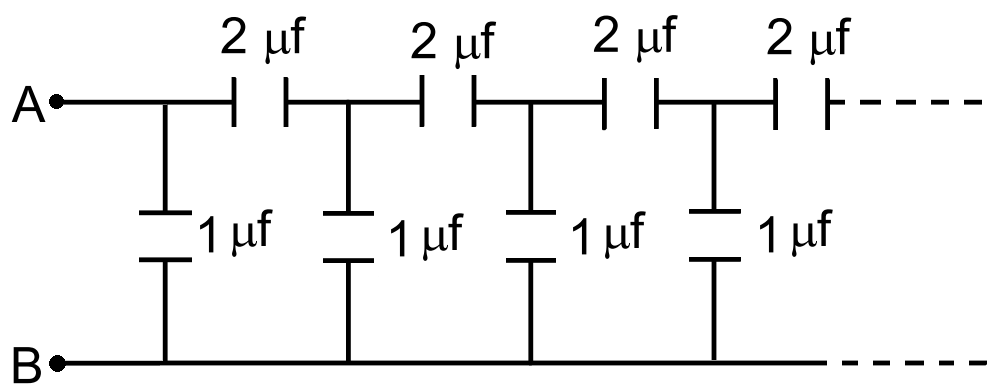
Find the equivalent capacitance of the infinite ladder shown in figure between the points A and B.
A rod of negligible heat cafacity has length $20\ cm,$ area of cross section $1.0\ cm$ and thermal conductivity $200\ Wm^{-1^\circ }C^{-1}.$ The temperature of one end is maintained at $0^\circ C$ and that of the other end is slowly and linearly varied from $0^\circ C$ to $60^\circ C$ in $10$ minutes. Assuming no loss of heat through the sides, find the total heat transmitted through the rod in these $10$ minutes.
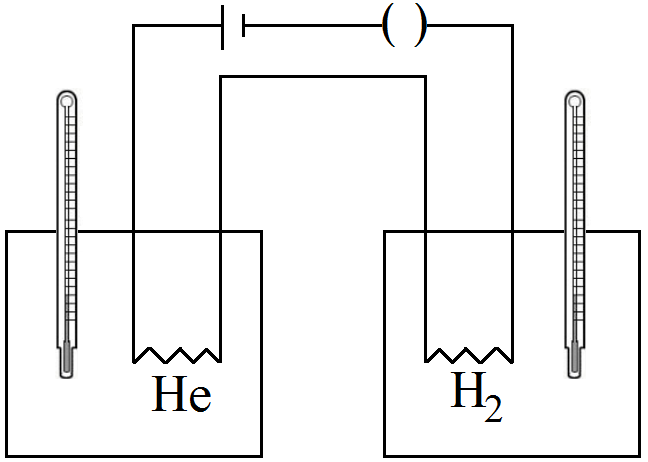
The figure shows two vessels with adiabatic walls, one containing $0.1g$ of helium $\big(\gamma=1.67,\text{M}=4\text{g-mol}^{-1}\big)$ and the other containing some amount of hydrogen $\big(\gamma=1.4,\text{M}=2\text{g-mol}^{-1}\big).$ Initially, the temperatures of the two gases are equal. The gases are electrically heated for some time during which equal amounts of heat are given to the two gases. It is found that the temperatures rise through the same amount in the two vessels. Calculate the mass of hydrogen.
In a series $\text{LCR}$ circuit with an $\text{AC}$ source, $\text{R}=300\Omega,\text{C}=20\mu\text{F},\text{L}=1.0\text{ henry},\epsilon_0=50\text{V}$ and $\nu=\frac{50}{\pi}\text{Hz}.$ Find:
  1. The rms current in the circuit.
  2. The rms potential difference across the capacitor, the resistor and the inductor. Note that the sum of the rms potential differences across the three elements is greater than the rms voltage of the source.
A coil of inductance $0.50H$ and resistance $100\Omega $ is connected to a $240V, 50Hz \ \ ac $supply.
  1. What is the maximum current in the coil?
  2. What is the time lag between the voltage maximum and the current maximum?