Question
What is a voltmeter? How can a galvanometer be converted into a voltmeter of given range? Explain.

Answer

SELF

Need a full question paper?

Generate a complete, print-ready paper with questions like this in minutes — across 16+ boards, with answer keys.

Start Generating Free

Similar questions

A train running at 108km/h towards east whistles at a dominant frequency of 500Hz. Speed of sound in air is 340m/s.
  1. What frequency will a passenger sitting near the open window hear?
  2. What frequency will a person standing near the track hear whom the train has just passed?
  3. A wind starts blowing towards east at a speed f 36km/h. Calculate the frequencies heard by the passenger in the train and by the person standing near the track.
A plane EM wave travelling along z direction is described by $\text{E}=\text{E}_0\sin(\text{kz}-\omega\text{t})\hat{\text{i}}\text{ and }\text{B}=\text{B}_0\sin(\text{kz}-\omega\text{t})\hat{\text{j}}$. Show that,

  1. The average energy density of the wave is given $\text{u}_\text{av}=\frac{1}{4}\in_0\text{E}_0^2+\frac{1}{4}\frac{\text{B}_0^2}{\mu_0}$.

  2. The time averaged intensity of the wave is given $\text{I}_\text{av}=\frac{1}{2}\text{c}\in_0\text{E}_0^2$.
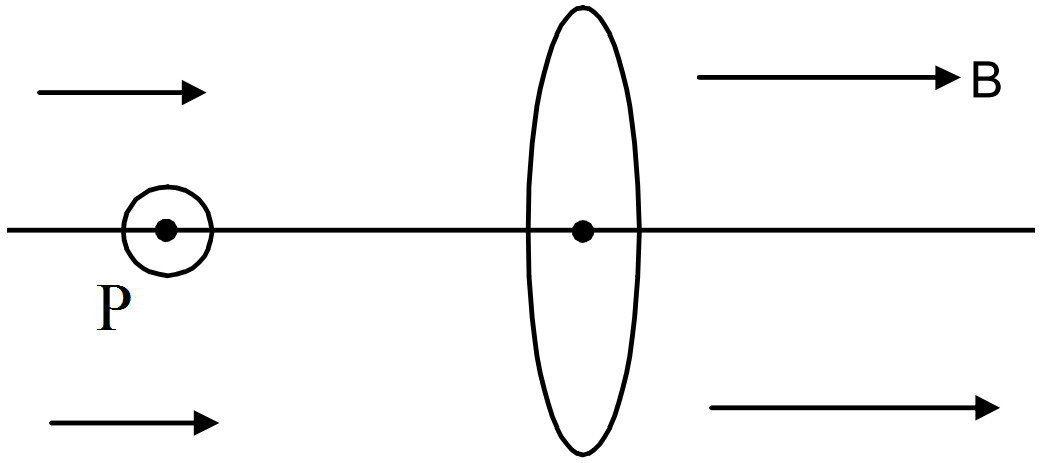
A coil of radius 10cm and resistance $40\Omega$ has 1000 turns. It is placed with its plane vertical and its axis parallel to the magnetic meridian. The coil is connected to a galvanometer and is rotated about the vertical dimeter through an angle of 180°. Find the charge which flows through the galvanometer if the horizontal component of the earth's magnetic field is $\text{B}_{\text{H}}=3.0\times10^{-5}\text{T}.$
  1. Using Biot-Savart’s law, derive the expression for the magnetic field in the vector form at a point on the axis of a circular current loop.
  2. What does a toroid consist of ? Find out the expression for the magnetic field inside a toroid for N turns of the coil having the average radius r and carrying a current I. Show that the magnetic field in the open space inside and exterior to the toroid is zero.
A neutron star has a density equal to that of the nuclear matter. Assuming the star to be spherical, find the radius of a neutron star whose mass is 4.0 × 1030kg (twice the mass of the sun).
Can static friction do nonzero work on an object? If yes, give an example. If no, give reason.
A rectangular conducting loop consists of two wires on two opposite sides of length l joined together by rods of length d. The wires are each of the same material but with cross-sections differing by a factor of 2. The thicker wire has a resistance R and the rods are of low resistance, which in turn are connected to a constant voltage source V0. The loop is placed in uniform a magnetic field B at 45° to its plane. Find $\tau$, the torque exerted by the magnetic field on the loop about an axis through the centres of rods.
Shows a convex lens of focal length 12cm lying in a uniform magnetic field B of magnitude 1.2T parallel to its principal axis. A particle with charge 2.0 × 10⁻³C and mass 2.0 × 10⁻⁵ kg is projected perpendicular to the plane of the diagram with a speed of 4.8 ms-1. The particle moves along a circle with its centre on the principal axis at a distance of 18cm from the lens. Show that the image of the particle moves along a circle and find the radius of that circle.

In the previous problem, suppose m2 = 2.0kg and m3 = 3.0kg. What should be the mass m so that it remains at rest?
The activity R of an unknown radioactive nuclide is measured at hourly intervals. The results found are tabulated as follows:
t(h) 0 1 2 3 4
R(MBq) 100 35.36 12.51 4.42 1.56
  1. Plot the graph of R versus t and calculate half-life from the graph.
  2. Plot the graph of 0 ln $\Big(\frac{\text{R}}{\text{R}_0}\Big)$ versus t and obtain the value of half-life from the graph.